|
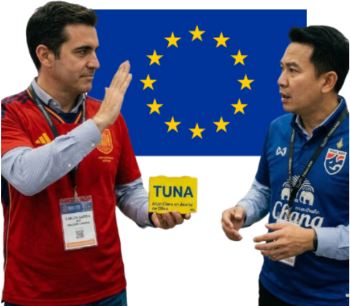
Recent industry data indicates a 22% to 37% increase in canned tuna imports into the European Union over the past year
EU Moves to Shield Tuna Cannery Industry from Thai Competition
 EUROPEAN UNION
Monday, October 05, 2026, 00:10 (GMT + 9)
European Commission Proposes Tariff Exemptions Conditional on Raw Material Caught Exclusively by Union Fleet
 The European Union faces a decisive moment for the future of its fishing and processing sectors following a proposal introduced by European Union Fisheries Commissioner Costas Kadis during bilateral free trade negotiations with Thailand. The measure aims to safeguard the EU canning industry by establishing a clause requiring imported canned tuna to be processed exclusively from fish caught by the European Union fleet. Failure to meet this requirement would maintain the general tariff rate of 24% on seafood products originating from the Asian nation.
This proposal arises amid the tenth round of trade negotiations with Thailand, scheduled to conclude on October 6. The European processing sector, notably led by the canning industry of Galicia in Spain, has voiced deep concern over the competitive scale imbalance separating both markets.
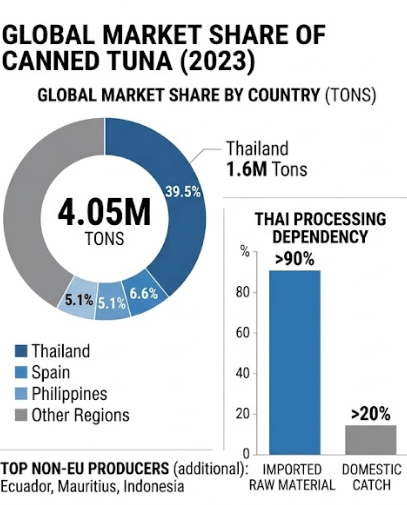
In 2023, Thailand spearheaded global canned tuna production, capturing 39.5% of the worldwide market, equivalent to 1.6 million tonnes. Conversely, Spain ranked fourth globally with a market share of 6.6%, while the Philippines occupied fifth place with 5.1%. Despite its dominance in tuna processing and exports, Thailand lacks a distant-water fishing fleet, requiring it to import over 90% of the raw material processed in its facilities.
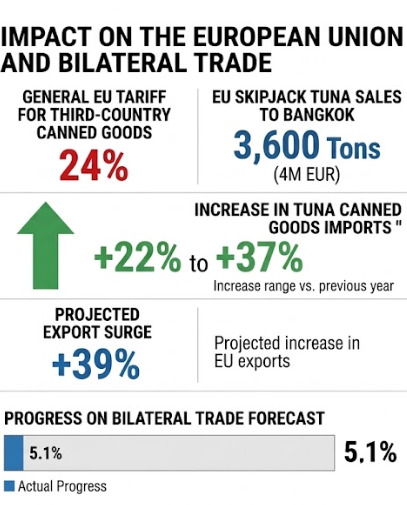 The volume of raw material trade between the EU fleet and the Thai market highlights this structural disparity. In 2024, European Union sales of frozen skipjack tuna (Katsuwonus pelamis) to Bangkok reached over 3,600 tonnes, valued at EUR 4 million. This figure accounts for less than 1% of total seafood imports entering the Asian processing hub.
European fisheries industry organizations, including Europêche, have warned of the growing impact of Asian imports on the EU market. Recent industry data indicates a 22% to 37% increase in canned tuna imports into the European Union over the past year, coinciding with a price reduction ranging from 6% to 22%. Furthermore, official projections suggest that a bilateral trade agreement could trigger an additional 39% surge in Thai tuna exports to the European market.
In response to these conditions, industry association Anfaco-Cytma, represented by Secretary General Roberto Alonso, has intensified institutional actions through strategic meetings with political groups in the European Parliament to demand operational safeguards and concrete protections for the EU seafood processing sector.
🇯🇵 JAPANESE
EU、タイとの競争から缶詰加工産業の保護へ
欧州委員会、域内漁船の単独捕獲原料を条件とする関税免除を提案
EU(欧州連合)とタイとの二国間自由貿易協定(FTA)交渉において、コスタス・カディスEU水産担当委員が提起した提案を受け、EUの漁業および水産加工業の未来は極めて重要な局面を迎えています。本措置は、輸入されるツナ缶詰の原材料をEUの漁船が捕獲した水産物のみに限定する条項を設けることで、域内の缶詰加工産業を保護することを目的としています。この条件を満たさない場合、同国からの水産加工品には24%の一般関税が適用され続けることになります。
本提案は、10月6日に妥結が予定されているタイとの第10回貿易交渉のさなかに発出されました。スペインのガリシア州に本拠を置く加工業者をはじめとする欧州の缶詰産業は、両国・地域間における競争規模の大きな不均衡に対して強い懸念を表明しています。
2023年におけるタイの世界のツナ缶詰生産シェアは39.5%(160万トン)に達し、世界首位の座を確立しました。これに対し、スペインはシェア6.6%で世界第4位、フィリピンは5.1%で第5位となっています。一方で、加工および輸出において圧倒的なシェアを誇るタイは自前の遠洋漁船勢力を保有しておらず、加工工場で消費する原材料の90%以上を輸入に依存しています。
EU漁船団とタイ市場との間における原材料取引量は、この構造的格差を裏付けています。2024年におけるEUからバンコクへの冷凍カツオ(Katsuwonus pelamis)の販売実績は3,600トン(総額400万ユーロ)超にとどまり、これはタイの水産物輸入全体の1%未満にすぎません。
Europêche(欧州漁業企業協会)をはじめとする欧州の水産団体は、域内市場におけるアジア産製品の台頭に対して警鐘を鳴らしています。過去1年間でEUへのツナ缶詰輸入量は22%から37%増加し、これに伴い販売価格は6%から22%下落しました。さらに、公式の試算では、二国間協定の締結によりタイ産ツナ製品の欧州市場向け輸出がさらに39%増加する可能性があると示されています。
こうした状況を受け、水産加工品事業者団体Anfaco-Cytmaのロベルト・アロンソ事務局長は、欧州議会の各政党会派との戦略的会合を重ね、域内水産加工業の基盤を守るための実効性あるセーフガード措置と運用の保証を強く求めています。
🇨🇳 中文 (Simplified Chinese Version) | 由人工智能自动翻译
欧盟采取行动保护本土金枪鱼罐头产业免受泰国竞争
欧洲委员会提出关税减免新条件:进口产品须完全采用欧盟船队捕捞的原料
随着欧盟水产委员科斯塔斯·卡迪斯(Costas Kadis)在与泰国的双边自由贸易协定谈判中提出一项新提议,欧盟的渔业及水产加工业迎来了关乎未来发展的关键时刻。该措施旨在通过设立专门条款保护欧盟本土的金枪鱼罐头加工业,要求进口的金枪鱼罐头必须完全由欧盟船队捕捞的海产品加工而成。若未能满足该条件,来自泰国的相关水产品将继续适用24%的通用关税税率。
该提议是在与泰国进行的第十轮贸易谈判期间提出的,本轮谈判预计将于10月6日结束。以西班牙****加利西亚地区为代表的欧洲罐头加工行业,对双方市场在竞争规模上的巨大差距表示了高度关切。
在2023年,泰国以占全球39.5%的市场份额(产量达160万吨)占据全球金枪鱼罐头生产的龙头地位。相比之下,西班牙以6.6%的份额位居全球第四,菲律宾则以5.1%位居第五。尽管泰国在加工和出口领域占据统治地位,但其缺乏远洋捕捞船队,导致其加工厂所需原料的90%以上依赖进口。
欧盟船队与泰国市场之间的原料贸易量清晰地反映了这一结构性差距。在2024年,欧盟向曼谷出口的冻鲣鱼(Katsuwonus pelamis)总量虽突破3,600吨,总价值达400万欧元,但这仅占该国海产品进口总量的1%以下。
包括Europêche(欧洲渔业企业协会)在内的欧洲渔业组织警告称,亚洲进口产品对欧盟市场的冲击正在加剧。过去一年中,进入欧盟的金枪鱼罐头进口量增长了22%至37%,与此同时,市场销售价格下降了6%至22%。此外,官方评估显示,双边贸易协定一旦签署,可能导致泰国金枪鱼对欧洲市场的出口量再激增39%。
面对这一局势,Anfaco-Cytma行业协会秘书长罗伯托·阿隆索(Roberto Alonso)已进一步加强机构斡旋,与欧洲议会内部的多个政治党团举行了战略会晤,坚决要求出台切实有效的保障措施,以维护欧盟水产加工业的生存与发展。
Noticia relacionada

[email protected]
www.seafood.media
|





 Print