|

Photo: Stockfile/FIS
Asian Tuna Markets Show Divergent Dynamics as Bangkok Skipjack Surges and Tokyo Records Resilient Bluefin Demand
 WORLDWIDE
Monday, October 12, 2026, 00:10 (GMT + 9)
Regional supply benchmarks highlight a 33.8% rally in cannery raw materials, while Tokyo's Toyosu auction clearly delineates premium bluefin from tropical species
Asian tuna trading centers continued to display sharply contrasting price patterns and varying degrees of transaction transparency entering the fourth quarter of 2026, according to official market reports compiled as of October 10, 2026. While Japan and Thailand provide structured, liquid pricing mechanisms for sashimi-grade and cannery-grade fish, public data from other major suppliers across Southeast Asia and East Asia remains less standardized.
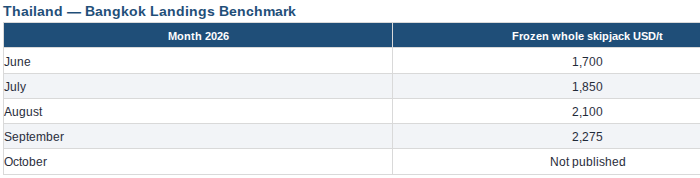
The strongest upward trajectory occurred in Thailand, the primary international price setter for whole frozen skipjack (Katsuwonus pelamis) destined for canning. Bangkok landing benchmarks published by Thai Union Group showed four consecutive months of steady increases, rising from $1,700 per metric ton in June 2026 to $1,850 per metric ton in July, $2,100 per metric ton in August, and reaching $2,275 per metric ton in September 2026. The cumulative gain from June to September reached 33.8%. The benchmark reflects contract dates, with vessels discharging raw materials at Bangkok processing hubs roughly one month post-transaction. Parallel public monthly series for yellowfin (Thunnus albacares) and bigeye (Thunnus obesus) remain unavailable in this channel.
Click on the image to enlarge it
In Japan, official daily records from the Tokyo Metropolitan Central Wholesale Market at Toyosu provide explicit classification between premium bluefin and lower-value tropical tunas. The market administration strictly separates its daily auction and negotiation lots by commercial species: maguro (まぐろ / bluefin tuna, Thunnus orientalis / Thunnus thynnus), kiwada (きわだ / yellowfin tuna, Thunnus albacares), mebachi (めばち / bigeye tuna, Thunnus obesus), and indo (いんど / albacore tuna, Thunnus alalunga or southern bluefin, Thunnus maccoyii). Because these categories reflect separate commercial destinations and quality tiers, wholesale prices in the maguro category represent the high-end bluefin sashimi sector rather than aggregate tropical volumes.
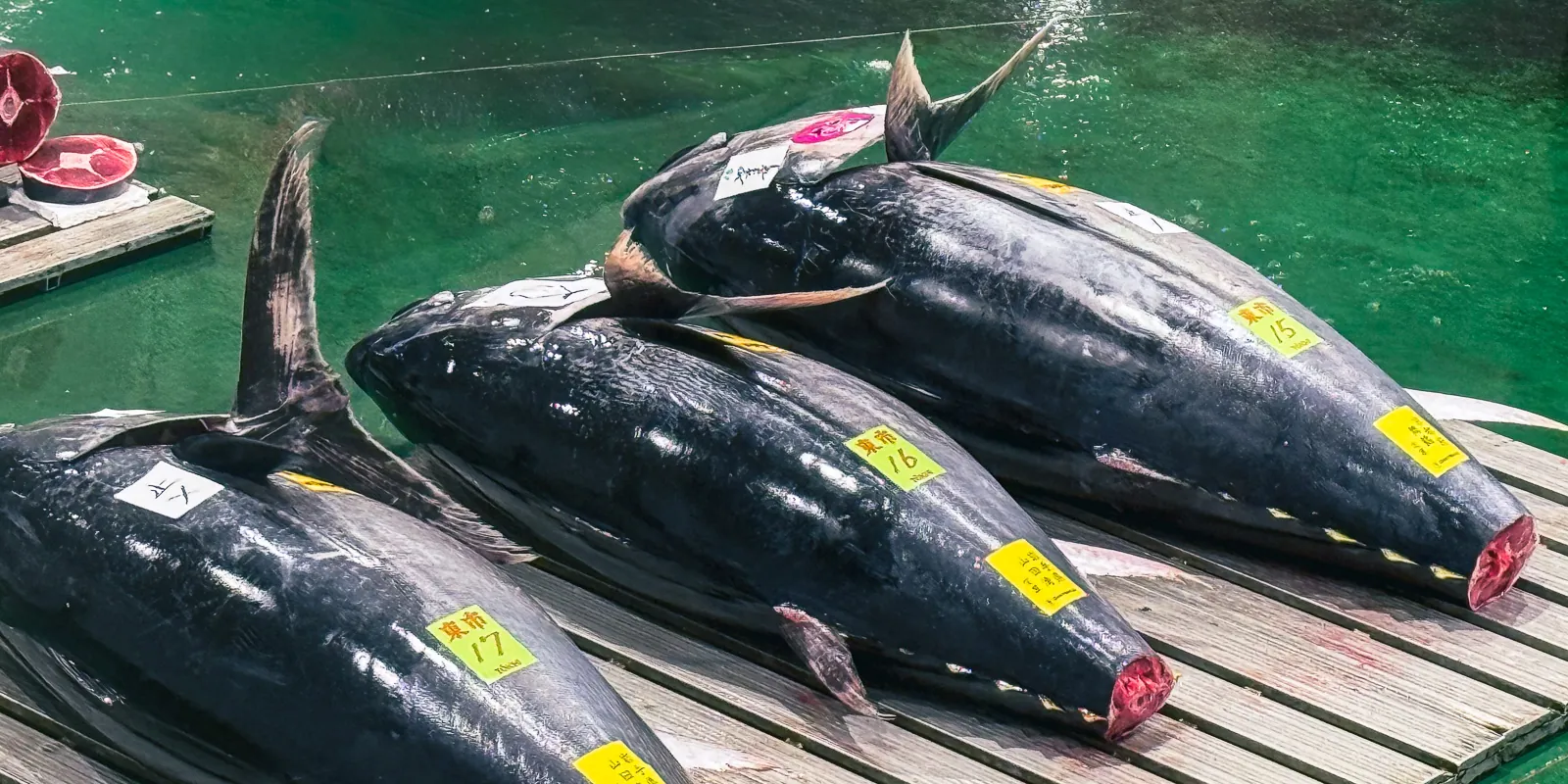
Photo: Tokyo Metropolitan Seafood Market Toyosu
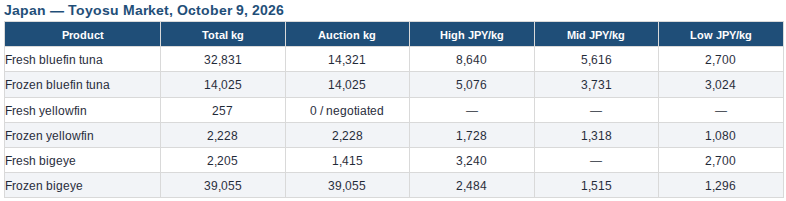
On October 9, 2026, Toyosu traded 32,831 kg of fresh bluefin tuna (maguro), of which 14,321 kg were sold through open auction. Fresh bluefin achieved a market high of ¥8,640 per kg ($54.50 per kg) and an average wholesale price of ¥5,616 per kg ($35.42 per kg). Frozen bluefin recorded 14,025 kg in total volume—all cleared via auction—reaching a peak of ¥5,076 per kg ($32.02 per kg) and an average of ¥3,731 per kg ($23.53 per kg).
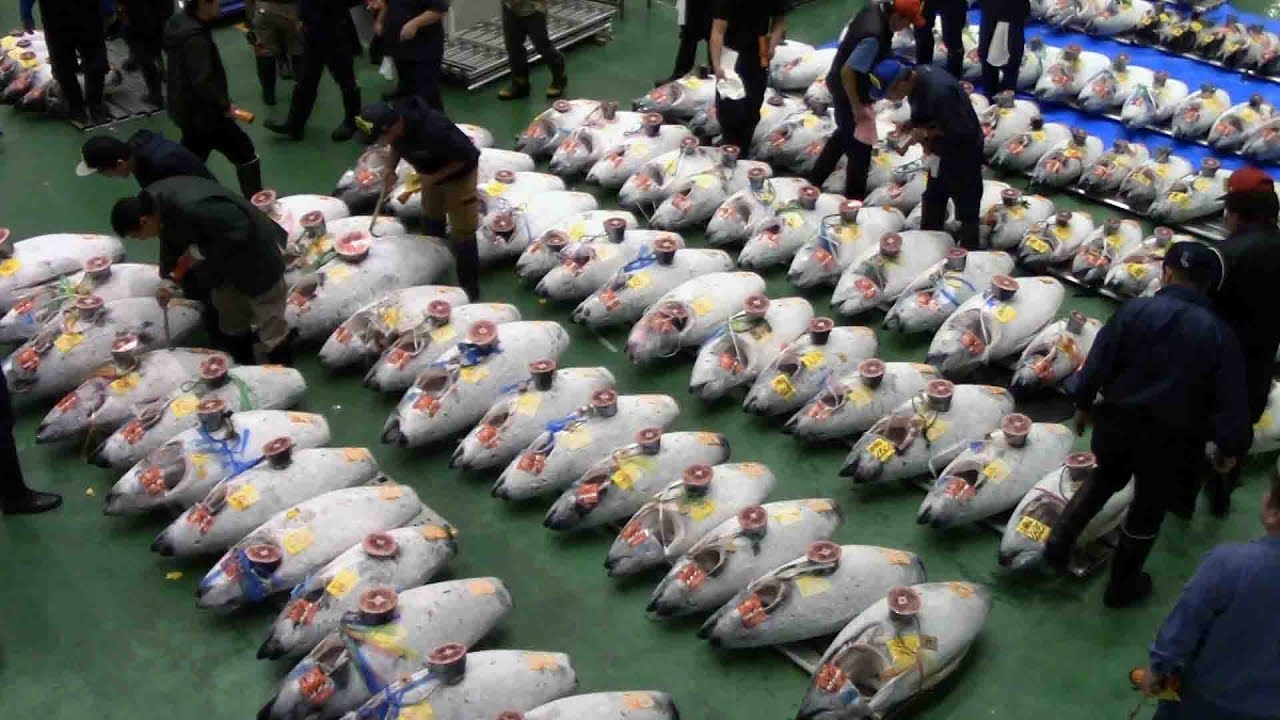
Photo: Tokyo Metropolitan Seafood Market Toyosu
In contrast, tropical species traded under distinct price tiers and supply channels at Toyosu. Frozen bigeye (mebachi) represented the single largest volume on the auction floor with 39,055 kg, clearing at a ceiling of ¥2,484 per kg ($15.67 per kg) and an average of ¥1,515 per kg ($9.56 per kg). Fresh bigeye registered 2,205 kg in total market volume (1,415 kg auctioned), reaching a top price of ¥3,240 per kg ($20.44 per kg). Frozen yellowfin (kiwada) totaled 2,228 kg, selling at an average of ¥1,318 per kg ($8.31 per kg) and a high of ¥1,728 per kg ($10.90 per kg), while fresh yellowfin was limited to 257 kg handled entirely through bilateral negotiated sales.

Click on the image to enlarge it
In Southeast Asia, wholesale figures published by Indonesia's Ministry of Marine Affairs and Fisheries (KKP) reflected domestic consumer levels across landing sites. National averages stood at Rp 45,000 per kg ($2.52 per kg) for tuna and Rp 37,857 per kg ($2.12 per kg) for skipjack (cakalang). Regional price variations showed lower quotes in North Jakarta during June 2026, where tuna averaged Rp 32,000 per kg ($1.79 per kg) and skipjack Rp 30,000 per kg ($1.68 per kg). By September 2026, wholesale centers in East Kalimantan reported values of Rp 50,000 per kg ($2.80 per kg) for tuna and Rp 45,000 per kg ($2.52 per kg) for skipjack. Regarding catch limits, Indonesia's official harvest allocation for 2026–2028 stands at 21,396 metric tons for bigeye tuna and 138,000 metric tons for skipjack.

Click on the image to enlarge it
In Taiwan, the Fisheries Agency wholesale network monitored terminal throughput across regional centers on October 7, 2026, including total multi-species market turnover of 134,350 kg in Fengshan, 311,041 kg in Kaohsiung, and 1,264,269 kg in Taipei 1. For the 2026 season, Taiwanese fleets in the Indian Ocean operate under catch quotas of 13,211 metric tons of bigeye tuna and 10,688 metric tons of yellowfin tuna.
Click on the image to enlarge it
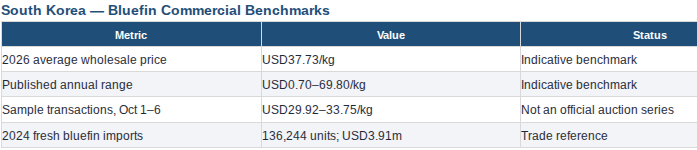
In South Korea, wholesale market assessments for bluefin tuna rely on indicative commercial trade intelligence rather than open centralized public auctions. Spot transactions documented between October 1 and October 6, 2026, hovered between $29.92 and $33.75 per kg, aligning with an annual indicative wholesale average of $37.73 per kg within an observed trading band of $0.70 to $69.80 per kg. These values follow total 2024 fresh bluefin import volumes of 136,244 units valued at $3.91 million.
🇯🇵 日本語 (Japanese Version) | AIによる自動翻訳
バンコクのカツオ急騰と東京の堅調なクロマグロ需要を背景に、アジアのマグロ市場は二極化の様相を呈す
地域供給指標は缶詰原料の33.8%高騰を浮き彫りにする一方、東京・豊洲市場のセリでは高級クロマグロと熱帯性マグロ類を明確に区分
2026年10月10日時点で集約された公式市場報告によると、2026年第4四半期に入るにあたり、アジアのマグロ取引ハブは対照的な価格推移と取引透明性のばらつきを示し続けている。日本とタイが生鮮刺身用および缶詰加工用魚類において構造化された流動性の高い価格形成メカニズムを提供する一方、東南アジアおよび東アジアの他の主要供給国からの公開データは依然として標準化が進んでいない。
最も顕著な上昇基調を記録したのは、缶詰向け冷凍正身カツオ(Katsuwonus pelamis)の国際価格決定役を担うタイである。タイ・ユニオン・グループ(Thai Union Group)が公表したバンコク水揚げ指標は4か月連続で着実な上昇を示し、2026年6月の1トンあたり1,700米ドルから、7月の1,850米ドル、8月の2,100米ドルを経て、2026年9月には1トンあたり2,275米ドルに達した。6月から9月にかけての累積上昇率は33.8%を記録した。この指標は契約日を反映しており、運搬船は取引確定から約1か月後にバンコクの加工拠点へ原料を陸揚げする。キハダマグロ(Thunnus albacares)およびメバチマグロ(Thunnus obesus)の同等の公開月次価格推移は、この系統では公表されていない。
日本では、東京都中央卸売市場豊洲市場の日報により、高級クロマグロと低価格帯の熱帯性マグロ類との明確な区分が示されている。市場当局は、日々のセリおよび相対取引ロットを商業魚種ごとに厳密に分類している:まぐろ(クロマグロ、Thunnus orientalis / Thunnus thynnus)、きわだ(キハダマグロ、Thunnus albacares)、めばち(メバチマグロ、Thunnus obesus)、いんど(ミナミマグロ、Thunnus maccoyii またはビンナガ、Thunnus alalunga)。これらの分類は個別の仕向け先および品質等級を反映しているため、「まぐろ」区分の卸売価格は熱帯性マグロ類の合算数値ではなく、高級クロマグロ刺身部門の実勢を正確に示している。
2026年10月9日、豊洲市場では生鮮クロマグロ(まぐろ)が32,831 kg取引され、そのうち14,321 kgがセリによって販売された。生鮮クロマグロの高値は1 kgあたり8,640円(54.50米ドル)、卸売平均価格は1 kgあたり5,616円(35.42米ドル)に達した。冷凍クロマグロは総取扱量14,025 kgを記録し、その全量がセリで取引され、高値は1 kgあたり5,076円(32.02米ドル)、平均価格は1 kgあたり3,731円(23.53米ドル)となった。
対照的に、熱帯性魚種は豊洲市場において異なる価格帯および流通経路で取引された。冷凍メバチ(めばち)はセリ場で最大の単一取引量を占め、39,055 kgが上場され、高値は1 kgあたり2,484円(15.67米ドル)、平均価格は1 kgあたり1,515円(9.56米ドル)で取引された。生鮮メバチは市場総量で2,205 kg(セリ取扱量1,415 kg)を記録し、高値は1 kgあたり3,240円(20.44米ドル)となった。冷凍キハダ(きわだ)は合計2,228 kgで、平均価格は1 kgあたり1,318円(8.31米ドル)、高値は1 kgあたり1,728円(10.90米ドル)で販売された一方、生鮮キハダはわずか257 kgにとどまり、全量が相対取引で処理された。
東南アジアでは、インドネシア海洋水産省(KKP)が発表した卸売価格が各水揚げ地における国内消費水準を反映している。全国平均価格はマグロ類全般で1 kgあたり45,000ルピア(2.52米ドル)、カツオ(チャカラン)で1 kgあたり37,857ルピア(2.12米ドル)となった。地域別の価格差として、2026年6月の北ジャカルタではマグロ類が平均1 kgあたり32,000ルピア(1.79米ドル)、カツオが1 kgあたり30,000ルピア(1.68米ドル)と低調であった。一方、2026年9月までに東カリマンタンの卸売市場ではマグロ類が1 kgあたり50,000ルピア(2.80米ドル)、カツオが1 kgあたり45,000ルピア(2.52米ドル)と報告された。漁獲割当に関して、インドネシアの2026〜2028年公式漁獲割当量は、メバチマグロが21,396トン、カツオが138,000トンに設定されている。
台湾では、漁業署の卸売ネットワークが2026年10月7日時点の地域ターミナル市場における取扱量を監視しており、複数魚種を合算した市場取扱量は鳳山で134,350 kg、高雄で311,041 kg、台北一で1,264,269 kgに達した。2026年漁期において、インド洋で操業する台湾船団にはメバチマグロ13,211トン、キハダマグロ10,688トンの漁獲枠が割り当てられている。
韓国におけるクロマグロの卸売市場評価は、中央公開セリではなく指標的な民間商業取引情報に依存している。2026年10月1日から10月6日の間に記録されたスポット取引価格は1 kgあたり29.92米ドルから33.75米ドルで推移し、年間指標卸売平均価格の1 kgあたり37.73米ドル(年間取引帯:1 kgあたり0.70〜69.80米ドル)と整合している。これらの数値は、2024年通年の生鮮クロマグロ輸入実績(136,244尾、金額ベース391万米ドル)に続く水準を示している。
🇨🇳 中文 (Simplified Chinese Version) | 由人工智能自动翻译
曼谷鲣鱼价格大涨与东京蓝鳍金枪鱼需求强劲显现,亚洲金枪鱼市场呈现分化走势
区域原料供应基准显示罐头原料大涨33.8%,而东京丰洲市场拍卖将高端蓝鳍金枪鱼与热带金枪鱼种明确区分
截至2026年10月10日编制的官方市场报告显示,在进入2026年第四季度之际,亚洲金枪鱼交易中心持续呈现出明显的价差走势与交易透明度分化。日本和泰国在刺身级与罐头加工级鱼品上提供了结构化且高流动性的定价机制,而东南亚和东亚其他主要供应国公布的公开数据依然缺乏标准化。
涨势最强劲的地区是泰国,该国是国际整条冷冻鲣鱼(Katsuwonus pelamis)罐头原料的核心定价中心。泰万盛集团(Thai Union Group)公布的曼谷卸港基准价连续四个月稳步攀升,从2026年6月的每公吨1,700美元上涨至7月的每公吨1,850美元、8月的每公吨2,100美元,并在2026年9月达到每公吨2,275美元。6月至9月的累计涨幅达到33.8%。该基准价反映合同签订日期,运输船通常在交易确认后约一个月在曼谷加工基地卸货。黄鳍金枪鱼(Thunnus albacares)和大眼金枪鱼(Thunnus obesus)在此渠道中尚无同等公开月度价格序列。
在日本,东京都中央批发市场丰洲市场的官方日报清晰展示了高端蓝鳍金枪鱼与低价值热带金枪鱼之间的严格区分。市场管理机构按商业鱼种严格划分每日拍卖与议价批次:maguro(まぐろ / 蓝鳍金枪鱼,Thunnus orientalis / Thunnus thynnus)、kiwada(きわだ / 黄鳍金枪鱼,Thunnus albacares)、mebachi(めばち / 大眼金枪鱼,Thunnus obesus)以及 indo(いんど / 长鳍金枪鱼,Thunnus alalunga 或南方蓝鳍金枪鱼,Thunnus maccoyii)。鉴于这些类别对应不同的商业流向与品质等级,maguro 类别下的批发价格完全代表高端蓝鳍刺身市场,而非热带金枪鱼的混合总量。
2026年10月9日,丰洲市场共交易了32,831公斤鲜活蓝鳍金枪鱼(maguro),其中14,321公斤通过公开拍卖成交。鲜蓝鳍金枪鱼市场最高价达到每公斤8,640日元(每公斤54.50美元),批发平均价为每公斤5,616日元(每公斤35.42美元)。冷冻蓝鳍金枪鱼总交易量为14,025公斤——全部通过拍卖成交——最高价达到每公斤5,076日元(每公斤32.02美元),平均价为每公斤3,731日元(每公斤23.53美元)。
相比之下,热带金枪鱼种在丰洲市场处于不同的价格梯队和供应渠道。冷冻大眼金枪鱼(mebachi)占据拍卖大厅最大单项交易量,共计39,055公斤,最高成交价为每公斤2,484日元(每公斤15.67美元),平均价为每公斤1,515日元(每公斤9.56美元)。鲜大眼金枪鱼市场总量为2,205公斤(拍卖量为1,415公斤),最高价达每公斤3,240日元(每公斤20.44美元)。冷冻黄鳍金枪鱼(kiwada)共计2,228公斤,平均价为每公斤1,318日元(每公斤8.31美元),最高价为每公斤1,728日元(每公斤10.90美元);而鲜黄鳍金枪鱼交易量仅为257公斤,全部通过双边议价完成。
在东南亚,印度尼西亚海洋事务与渔业部(KKP)公布的批发数据反映了各卸货港的国内消费水平。全国平均批发价为金枪鱼类每公斤45,000印尼盾(每公斤2.52美元),鲣鱼(cakalang)每公斤37,857印尼盾(每公斤2.12美元)。区域价差显示,2026年6月在北雅加达,金枪鱼平均价为每公斤32,000印尼盾(每公斤1.79美元),鲣鱼为每公斤30,000印尼盾(每公斤1.68美元)。到2026年9月,东加里曼丹批发中心记录的金枪鱼价格达每公斤50,000印尼盾(每公斤2.80美元),鲣鱼达每公斤45,000印尼盾(每公斤2.52美元)。在捕捞配额方面,印度尼西亚官方核定的2026–2028年捕捞限额分别为大眼金枪鱼21,396公吨和鲣鱼138,000公吨。
在台湾,渔业署批发监测网络于2026年10月7日对区域集散市场的多鱼种综合吞吐量进行了监控,其中凤山市场总交易量为134,350公斤,高雄为311,041公斤,台北一为1,264,269公斤。在2026年度渔汛期,台湾在印度洋作业的船队拥有官方配额,大眼金枪鱼为13,211公吨,黄鳍金枪鱼为10,688公吨。
在韩国,蓝鳍金枪鱼的批发市场评估主要依赖代表性商业贸易情报,而非集中的公开官方拍卖。在2026年10月1日至10月6日期间记录的现货交易价格介于每公斤29.92至33.75美元之间,与全年度每公斤37.73美元的指导性批发均价基本吻合(全年交易区间为每公斤0.70至69.80美元)。这些数值紧随2024年鲜蓝鳍金枪鱼全年进口规模展开,当年进口总量为136,244尾,总价值391万美元。
[email protected]
www.seafood.media
|





.png)
.png)
.png)
.png)
 Print