|
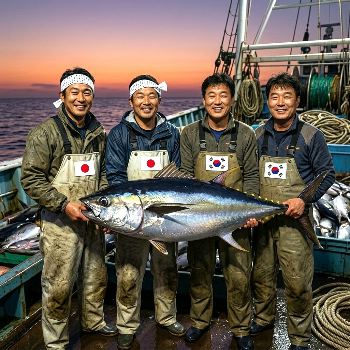
AI-generated image
South Korea and Japan to Increase Bluefin Tuna Catch Starting Next Year
 JAPAN
JAPAN
Thursday, August 20, 2026, 03:10 (GMT + 9)
Countries Agree to Raise Bluefin Tuna Quota by 25% Following Exhaustion of International Caps and Resource Recovery
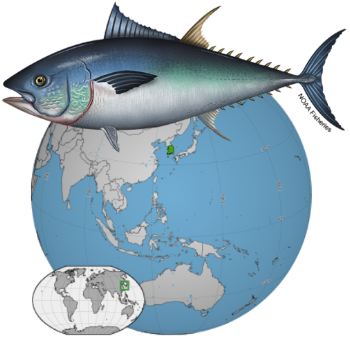
SEOUL / TOKYO – Nations involved in the Pacific bluefin tuna (Thunnus orientalis) fishery have agreed to increase the catch limit for large-sized specimens by 25% starting next year, according to multilateral negotiations reported by the Nihon Keizai Shimbun. The measure aims to alleviate severe economic and operational pressures on domestic fishermen in South Korea and Japan, who have been routinely forced to discard incidental catches caught in their nets due to the premature exhaustion of their allocated quotas.
The agreement was reached following a virtual meeting attended by delegations from South Korea, Japan, the United States, Taiwan, Mexico, and other member nations of the regional regulatory body. During the session, participating parties finalized the adjustment plan for managing Pacific bluefin tuna in the Pacific Ocean.
Differentiated Adjustment Based on Resource Size
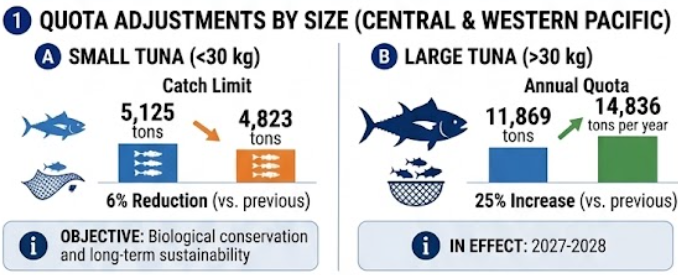
Under the agreed terms, the global annual catch quota for large bluefin tuna—defined as individuals weighing over 30 kg—in the Central and Western Pacific Ocean region will increase from 11,869 tons to 14,836 tons per year.
In contrast, to explicitly guarantee biological conservation and long-term sustainability, the catch limit for juvenile or small-sized specimens—weighing less than 30 kg—will undergo a 6% reduction, decreasing from 5,125 tons to 4,823 tons. This dual approach balances juvenile resource protection with the operational demands of commercial and artisanal fishing fleets by concentrating harvesting efforts on fully mature individuals. The updated operational caps will remain in effect for two years, strictly covering the period from 2027 to 2028.
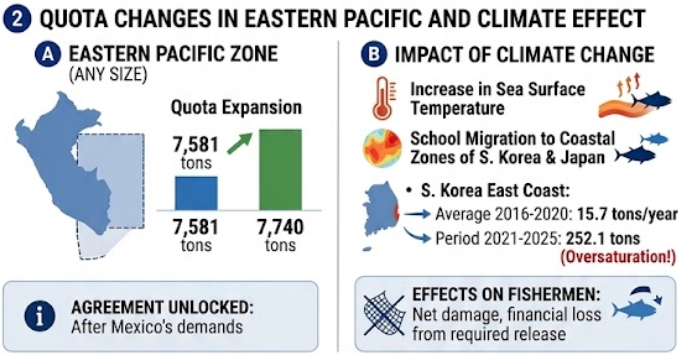
Concurrently, participating nations agreed to expand the catch quota in the Eastern Pacific Ocean from 7,581 tons to 7,740 tons, regardless of fish weight categories. This final consensus unlocked global negotiations, which had nearly concluded during an international conference held in Nagasaki, Japan last month, but were temporarily halted due to additional demands raised by Mexico for increased catch allowances in the eastern sector.
Impact of Climate Change in East Asian Coastal Waters
Both South Korea and Japan actively advocated for higher catch limits in response to a direct ecological shift: continuous sea surface temperature increases driven by global climate change. This thermal variation has triggered a massive migration of bluefin tuna schools into the territorial waters and exclusive economic zones of both countries, particularly along the eastern coast of the Korean Peninsula.
Official statistics demonstrate the scale of this shift: recorded catches along the East Coast of South Korea surged from an annual average of 15.7 tons during the 2016–2020 period to an extraordinary 252.1 tons between 2021 and 2025.
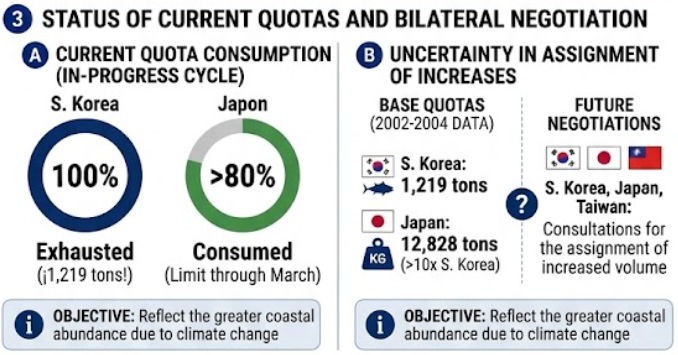
As a result of this unusual abundance, South Korea completely exhausted its allocated annual quota for the current fishing cycle. Meanwhile, Japón has consumed over 80% of its annual limit, which remains valid through March of next year. This scenario sparked intense protests from regional fishing associations, as large quantities of bluefin tuna entered fixed set nets intended for other commercial species. Bound by legal prohibitions against landing over-quota fish, fishermen were forced to release the tuna back into the ocean, sustaining net damage and substantial financial losses.
Quota Allocation and Bilateral Negotiation Uncertainty
Despite broad consensus on the overall global quota expansion, South Korea, Japan, and Taiwan must undergo further consultations to establish the precise allocation of the increased volume among their respective fleets.
Currently, the baseline quota framework allocates 1,219 tons to South Korea, while Japan holds 12,828 tons, a figure more than ten times greater than the South Korean allocation. This historical disparity stems from baseline calculations established using catch data from the 2002–2004 period.
Industry attention across Asia is now focused on the capability of South Korean maritime authorities to negotiate a substantial quota increase, citing structural environmental shifts in marine distribution caused by the climate crisis in the East Sea. The revised national allocations are scheduled for implementation starting with next year's fishing season.
Related news:
韓国と日本、来年からマグロ漁獲枠を引き上げへ
国際枠の消化と資源回復を受け、大型太平洋クロマグロの漁獲枠を25%拡大することで合意
ソウル / 東京 – 太平洋クロマグロ(Thunnus orientalis)漁業の諸加盟国は、日本経済新聞が報じた多国間交渉に基づき、大型魚の漁獲上限を来年から25%引き上げることで合意しました。この措置は、割り当てられた漁獲枠が早期に消化されたことで、定置網などにかかったクロマグロを海に再放流・破棄せざるを得ず、深刻な経済的・操業的打撃を受けている韓国および日本の沿岸漁業者の負担を軽減することを目的としています。
この合意は、韓国、日本、米国、台湾、メキシコなどの地域管理機関加盟国の代表団が参加したオンライン会議を経て妥結されました。会議において、各参加国は太平洋におけるクロマグロ管理調整案を最終決定しました。
魚体サイズに応じた階層的調整
合意された条件に基づき、中西部太平洋海域における大型クロマグロ(30kg以上)の年間全体漁獲枠は、従来の年間11,869トンから14,836トンへと増枠されます。
対照的に、資源保護と生物学的持続可能性を確実に維持するため、小型魚(30kg未満)の漁獲上限は、従来の5,125トンから4,823トンへと約6%削減されます。この二段階のアプローチは、未成魚の保護を図りつつ、成熟した大型魚に漁獲を集中させることで、漁業現場の需要と資源管理の両立を目指しています。新たな操業上限枠は2027年から2028年までの2年間にわたり適用されます。
同時に、東太平洋海域における漁獲枠についても、魚体の大きさを問わず7,581トンから7,740トンへ拡大することで合意しました。先月、長崎で開催された国際会議において、日本の提案を軸に合意寸前まで達しながらも、東太平洋での枠拡大を求めたメキシコの追加要求により中断していた多国間交渉が、今回の合意により最終妥結に至りました。
東アジア沿岸域における地球温暖化の影響
韓国と日本は、地球温暖化に伴う海水温の上昇という生態系変化に直面し、漁獲枠の拡大を積極的に主張してきました。水温の上昇に伴い、クロマグロの群れが両国の領海および排他的経済水域(EEZ)、特に朝鮮半島東海岸沖へ大量に回遊するようになっています。
公的データはこの変化を明確に示しています。韓国東海岸における関連漁獲量は、2016年〜2020年の年平均15.7トンから、2021年〜2025年には252.1トンへと急増しました。
この異例の資源流入により、韓国は今年度の割り当て枠をすでに完全に使い切りました。一方、日本も来年3月までを期限とする年間漁獲枠の80%以上を消化しています。他の魚種を狙って設置された定置網に大量のクロマグロが入網するため、枠超過による再放流義務が生じ、網の破損や通常操業の妨害など、両国の漁業者から強い不満の声が上がっていました。
国別配分と二国間交渉の展望
全体枠の拡大については合意が形成されたものの、今回増枠された漁獲枠を韓国、日本、台湾の間でどのように再配分するかについては、更なる協議が必要とされています。
現在の基本枠は、韓国が1,219トンであるのに対し、日本は12,828トンと10倍以上の格差が存在します。この歴史的な配分比率は、2002年〜2004年の実績データを基準に決定されたものです。
海洋環境の変化に伴い日本海・東海沿岸での来遊量が増加している実態を踏まえ、韓国当局が来年度からの適用に向けてどこまで配分枠の拡大を交渉できるか、アジアの漁業関係者の注目が集まっています。
韩国与日本将于明年起提高金枪鱼捕捞限额
鉴于国际限额耗尽及资源复苏,多国同意将大型蓝鳍金枪鱼捕捞上限提升25%
首尔 / 东京 – 据日本经济新闻报道,在最近结束的多边谈判中,涉及太平洋蓝鳍金枪鱼(Thunnus orientalis)捕捞的国家已达成一致,决定自明年起将大型个体金枪鱼的捕捞限额提高25%。此举旨在缓解韩国与日本本土渔民面临的严重经济和生产压力。此前,由于分配配额提前耗尽,两国渔民被迫将误入网具的金枪鱼大量丢弃回海中。
该协议是在韩国、日本、美国、台湾、墨西哥等区域管理组织成员国代表出席的视频会议上达成的。在会谈期间,各方最终确定了太平洋区域蓝鳍金枪鱼捕捞量的调整方案。
基于资源体型的差异化调整方案
根据达成的协议条款,在中西部太平洋海域,针对单种重量在30公斤以上的大型蓝鳍金枪鱼,其全球年度捕捞配额将从每年11,869吨增加至14,836吨。
与此相对,为了确保生物资源保护和可持续利用,针对单种重量在30公斤以下的未成熟或小型金枪鱼,捕捞限额将减少约6%,从5,125吨降至4,823吨。这种双重机制既保护了幼鱼资源,又通过将捕捞重点转向已完全性成熟的个体,回应了商业渔业的现实需求。新的操作限额设定为期两年,将于2027年至2028年期间严格执行。
同时,各参与国还同意将东太平洋海域的捕捞配额从7,581吨提高至7,740吨,且不区分鱼体大小。上月在日本长崎举行的国际会议上,谈判曾接近根据日本提出的方案达成协议,但随后因墨西哥要求进一步扩大东太平洋的捕捞量而暂时中断。本次共识的达成标志着全球谈判的全面落定。
气候变化对东亚沿海海域的影响
韩国与日本均积极倡导扩大捕捞限额,其核心驱动力在于全球气候变化引发的海水温度持续上升这一直接生态变化。水温的变化导致蓝鳍金枪鱼鱼群大量迁移至两国的领海及专属经济区,特别是朝鲜半岛东部沿海海域。
官方统计数据直观地反映了这一趋势:韩国东海岸的相关捕捞量从2016—2020年期间的年均15.7吨,猛增至2021—2025年期间的252.1吨。
由于金枪鱼资源的大幅增加,韩国已完全耗尽了本年度分配的配额。与此同时,日本也已消耗了其截至明年3月的年度配额的80%以上。由于大量金枪鱼闯入为捕捞其他经济鱼类而设置的固定网具中,受限于超配额禁止上岸的法律规定,渔民不得不将金枪鱼放归大海,这不仅损坏了渔具,也造成了严重的经济损失,引发了捕捞业界的强烈不满。
配额分配与双边谈判的不确定性
尽管各方已就总体配额扩大达成共识,但韩国、日本与台湾之间仍需进行进一步协商,以确定新增捕捞配额在各方舰队之间的具体分配比例。
在现有的基础配额框架下,韩国获得的配额为1,219吨,而日本的配额高达12,828吨,是韩国配额的十倍以上。这一历史性的分配差距源于基于2002—2004年期间捕捞数据所设定的基准。
鉴于近期气候变化导致东海/日本海沿岸捕捞量大幅上升,韩国海洋渔业部门能否在谈判中争取到大幅提高配额分配,成为整个亚洲渔业关注的焦点。调整后的配额计划将于明年的捕捞季开始正式实施。
[email protected]
www.seafood.media
|





 Print
Print