|
For exporters, the consultation opens a period of regulatory uncertainty, as well as an opportunity to shape system design
US initiates comprehensive review of rules governing seafood product imports
 UNITED STATES
Thursday, July 30, 2026, 04:00 (GMT + 9)
NOAA Fisheries requests public comments on the evaluation system for marine mammal bycatch in foreign fisheries for potential regulatory updates
Washington, United States. The US Government has initiated a comprehensive review of the rules governing the access of foreign seafood products to its market based on marine mammal protection.
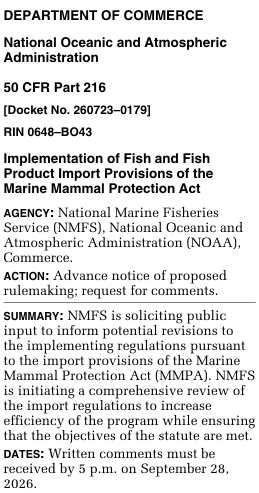
The National Oceanic and Atmospheric Administration (NOAA) opened a public consultation to examine potential changes to the implementation of import provisions under the Marine Mammal Protection Act (MMPA). Public comments may be submitted until 5:00 PM on September 28, 2026.
The initiative does not yet alter entry conditions or suspend existing restrictions. It represents a preliminary phase through which NOAA Fisheries seeks to gather information prior to drafting, if appropriate, a proposed rule.
Nevertheless, the scope of the consultation makes the process a high-priority matter for exporting governments, fishing fleets, processors, traders, and importers. The agency is soliciting feedback on nearly all operational components of the system: the definition of US standards, the evaluation of foreign fisheries, review cycles, trade prohibitions, customs documentation, and traceability of goods processed in third countries.
A system encompassing approximately 2,500 fisheries
The MMPA requires the United States to prohibit the import of seafood and fish products from fisheries where incidental mortality or serious injury of marine mammals exceeds US fleet standards.
To fulfill this mandate, NOAA classifies foreign fisheries and evaluates whether their monitoring, regulatory, and bycatch reduction programs are comparable in effectiveness to the US system.
The first full round of evaluations encompassed approximately 2,500 fisheries across 135 countries, according to official documentation. NOAA acknowledges that the process proved significantly more complex than anticipated and, including several extensions, took more than three years to complete.
The agency attributes these difficulties to differences among countries regarding legislation, institutional capacity, data quality, monitoring programs, mitigation measures, and scientific knowledge of marine mammal stocks.
Evaluations are conducted on a fishery-by-fishery basis. When a fishery fails to receive a favorable comparability finding, products harvested from it may become subject to an import prohibition. The restriction takes effect 30 days after NOAA publishes the corresponding denial and remains active until the fishery demonstrates compliance with the required standards.
Potential conditional comparability findings
One of the most significant issues raised by NOAA is the potential introduction of conditional comparability findings. This mechanism would allow certain countries a consultation or adaptation period to address deficiencies before an immediate import prohibition is imposed.
The agency also inquires whether it should prioritize evaluations based on the conservation status of marine mammals and the actual risk of bycatch. Another topic under discussion is the exclusion of fisheries that, due to their gear type or other characteristics, are determined to have minimal impacts.
These questions do not predetermine the outcome of future rulemaking. The review could simplify certain obligations, but it could also yield more defined requirements or tighter controls focused on fisheries and supply chains identified as higher risk.
Furthermore, NOAA asks for input on whether the economic impacts on small-scale operators, producing countries, and commercial enterprises should be taken into account within the comparability assessment process.
.png)
Traceability and potential border delays
The review also encompasses the Certificate of Admissibility (COA), used to demonstrate that a shipment does not originate from a prohibited fishery. The document must be validated by a competent authority in the harvesting or exporting country and submitted to US Customs and Border Protection via the Automated Commercial Environment system.
The certificate is particularly critical when authorized products share tariff codes with restricted commodities. NOAA recognizes that commercial codes alone do not allow for the identification of the specific fishery of origin.
The agency notes that coordination among foreign authorities, fishing companies, importers, and US agencies can lead to port delays, administrative burdens, and enforcement challenges.
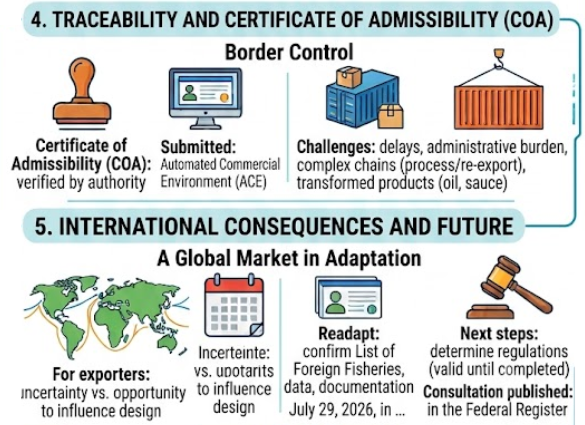
The issue escalates when fish is landed in one country, processed in a second, and re-exported from a third. Regulations prevent goods originating from a prohibited fishery from bypassing restrictions through intermediate processing nations, requiring these countries to maintain procedures capable of certifying the admissible origin of the product.
Highly processed items, such as fish oil or fish sauce, present additional challenges. In some cases, determining the exact species or linking the finished product to a specific fishery proves difficult.
A consultation with international ramifications
NOAA seeks proposals to improve system efficiency without compromising conservation goals or creating a disadvantage for US fishers. Potential modifications include altering the current four-year review cycle, clarifying what constitutes a program "comparable in effectiveness," and tailoring evaluation frameworks for data-limited countries.
For exporters, the consultation opens a period of regulatory uncertainty, as well as an opportunity to shape system design. Countries with significant exposure to the US market will need to review their fisheries listed on the List of Foreign Fisheries, active findings, bycatch documentation, and traceability mechanisms.
The immediate priority will be determining which proposals advance into formal proposed regulations. Until such time, current comparability findings, prohibitions, and documentation requirements remain fully in effect.
The consultation notice was published on July 29, 2026, in the US Federal Register.
🇯🇵 日本語 (Japanese Version)
米国、水産物輸入を律する規制の全面見直しに着手
NOAA水産局、外洋漁業における海生哺乳類の混獲評価制度に関するパブリックコメントの募集を開始、将来的な規制改正を視野に
米国・ワシントン。米国政府は、海生哺乳類の保護基準に基づき外国産水産物の自国市場へのアクセスを規定するルールの全面的見直しに着手した。
海洋大気庁(NOAA)は、海洋哺乳類保護法(MMPA)の輸入規定の適用に関する潜在的な変更を検討するため、パブリックコメントの募集を開始した。意見公募の締め切りは2026年9月28日17時00分となっている。
本取り組みは、現時点で輸入条件を変更したり、有効な制限措置を停止したりするものではない。NOAA水産局が規制案の策定に先立ち、情報を収集するための予備的段階に位置付けられている。
しかしながら、本協議の範囲の広さから、本プロセスは輸出国の政府、漁業者、加工業者、販売業者、輸入業者にとって最優先課題となっている。同庁は、米国基準の定義、外国漁業の評価、見直し周期、禁輸措置、税関書類、第三国で加工される商品のトレーサビリティなど、制度のほぼすべての運用構成要素について意見を求めている。
約2,500の漁業に影響を及ぼす制度
MMPAは米国に対し、海生哺乳類の偶発的死亡または重傷化(混獲)が米国漁船団に適用される基準を超える漁業からの水産物および水産加工品の輸入を禁止することを義務付けている。
この法的義務を履行するため、NOAAは外国の漁業を分類し、そのモニタリング、規制、混獲削減プログラムが米国制度と同等の有効性を有しているか(同等性評価)を審査している。
公式文書によると、第1回目の包括的評価の対象は135ヶ国・地域の約2,500の漁業に及んだ。NOAAは、このプロセスが予想以上に極めて複雑であり、複数回の期限延長を含め、完了までに3年以上を要したことを認めている。
同庁はこの難航の理由として、各国の法制度、行政能力、データ品質、監視プログラム、軽減措置、ならびに海生哺乳類の資源量に関する科学的知見の格差を挙げている。
評価は漁業ごとに行われる。漁業が適格な同等性認定を取得できなかった場合、当該漁業で獲れた水産物は輸入禁止措置の対象となる可能性がある。制限はNOAAが不認定を公表してから30日後に効力を発し、当該漁業が要求条件への適合を証明するまで継続する。
条件付き同等性認定の導入可能性
NOAAが提起した最も重要な論点の一つは、条件付き同等性認定の導入可能性である。この仕組みが導入されれば、即座に禁輸措置を課す前に、特定国に対して不備を修正するための協議・適応期間が猶予されることになる。
同庁はまた、海生哺乳類の保全状況や実際の混獲リスクに応じて評価の優先順位を決めるべきかについても意見を求めている。さらに、漁具の種類やその他の特性から影響が軽微とみなされる漁業を除外するかどうかも議論の対象となっている。
これらの設問は、将来の規制結果を予断するものではない。見直しによって一部の義務が簡素化される可能性がある一方で、リスクが高いとみなされる漁業やサプライチェーンに対して、より明確な要件や厳格な管理が導入される可能性もある。
NOAAはさらに、小規模事業者、生産国、商業企業への経済的影響を同等性評価のプロセスにおいて考慮すべきかについても意見を収集している。
トレーサビリティと国境での停滞リスク
見直しの対象には、貨物が禁止対象の漁業に由来しないことを証明するために使用される適合証明書(COA)も含まれる。同文書は生産国または輸出国のおのおのの管轄当局によって証明され、米国税関・国境取締局の自動商業環境(ACE)システムを通じて提出されなければならない。
この証明書は、許可された製品が制限対象商品と同じ関税分類コード(HSコード)を共有している場合に特に重要となる。NOAAは、貿易用コードのみでは元となる個別の漁業を特定できないことを認めている。
同庁は、外国当局、漁業会社、輸入業者、米国機関の間の連携不足が、港湾での遅延、行政負荷の増大、取締り上の困難を引き起こす可能性があると指摘している。
魚が特定の国で揚げられ、別の国で加工され、さらに第三国から再輸出される場合、問題は一段と複雑化する。規制により、禁止漁業由来の貨物が中間国を経由して制限を回避することは禁じられており、中間国にも製品の適格な原産地を証明できる手順を備えることが求められる。
魚油や魚醤などの高度加工品は、さらなる困難を伴う。場合によっては、正確な魚種の特定や、完成品と特定の漁業との紐付けが困難となる。
国際的な影響を伴うパブリックコメント
NOAAは、保全目標を損なうことなく、また米国漁業者に不利を生じさせない形で、制度の効率性を向上させるための提案を求めている。選択肢には、現行の4年サイクルの見直しの変更、プログラムが「同等の有効性を有する」ことの定義の明確化、データが限られた国に対する評価枠組みの適合などが含まれる。
輸出国にとって、このパブリックコメントは規制上の不確実性の期間をもたらす一方で、制度設計に影響を与える好機でもある。米国市場への依存度が高い国は、外国漁業リスト(LOFF)に掲載されている自国の漁業、現在の認定状況、混獲に関する証明文書、およびトレーサビリティの仕組みを再点検する必要がある。
当面の最優先事項は、どの提案が正式な規制案として結実するかを見極めることである。それまでの間は、現行の同等性認定、禁輸措置、および書類要件がそのまま適用され続ける。
本パブリックコメントは、2026年7月29日付の米国官報(Federal Register)にて公表された。
🇨🇳 简体中文 (Simplified Chinese Version)
美国就调节水产品进口规则启动全面审查
美国国家海洋和大气管理局渔业局就评估外国渔业海洋哺乳动物副渔获物的制度征求公众意见,以备调整法规
美国华盛顿。美国政府已针对基于海洋哺乳动物保护原则限制外国水产品进入其市场的规则启动了全面审查。
美国国家海洋和大气管理局(NOAA)发起了一项公众咨询,旨在研究《海洋哺乳动物保护法》(MMPA)进口条款执行细则的潜在修改。公众意见反馈截止时间为2026年9月28日17:00。
该举措目前尚未改变准入条件,也未暂停现行限制措施。这属于初步阶段,NOAA Fisheries 意在制定具体的监管法规提案前收集相关信息。
然而,鉴于本次咨询涉及面广,该进程已成为各出口国政府、捕捞舰队、加工企业、贸易商及进口商的高优先级事务。该机构正就该系统几乎所有的运行环节征求意见:美国标准的定义、外国渔业的评估、审查周期、贸易禁令、海关单证以及在第三方国家加工货物的可追溯性。
覆盖约2,500个渔业的评估体系
MMPA 强制要求美国禁止进口来自其海洋哺乳动物偶发性死亡或重伤(副渔获)率超过美国舰队适用标准的水产品及衍生品。
为履行这一法定职责,NOAA 对外国渔业进行分类,并评估其监管、监控及副渔获物减少计划在有效性上是否与美国体系具备可比性。
官方文件显示,首轮完整的评估共涉及来自 135个国家和地区 的约 2,500个渔业。NOAA 承认,该评估过程的复杂程度远超预期,包含多次延期在内,历时 三年多 才告完成。
该机构将这些困难归因于各国在法律法规、机构能力、数据质量、监控计划、缓解措施以及对海洋哺乳动物种群科学认知方面的客观差异。
评估按具体渔业逐一进行。当某项捕捞活动未能获得有利的可比性认定(等效认定)时,其捕获的水产品可能面临进口禁令。限制措施将在 NOAA 发布拒绝公告 30天后 正式生效,并保持实施状态,直至该渔业证明其符合所需条件。
引入有条件可比性认定的可能性
NOAA 提出的最关键议题之一是引入有条件可比性认定的可行性。这一机制将允许特定国家在被直接实施禁令前,获得一段协商或调整期,以纠正存在的问题。
该机构还询问是否应根据海洋哺乳动物的濒危保护状况及副渔获物的实际风险来确定评估的优先顺序。另一个讨论焦点是是否排除那些因所用渔具特性或其它特征而被认为影响极微的渔业。
这些问题并不预示未来法规的最终结果。审查可能会简化部分合规义务,但也可能对被认定为高风险的渔业和供应链出台更明确的要求或实施更具针对性的监管。
此外,NOAA 还征求关于在等效性评估过程中,是否应考虑对小型捕捞业主、生产国及商业企业的经济影响。
可追溯性与边境潜在滞留风险
本次审查范围还涵盖了用于证明货物并非来自被禁渔业的准入证书(COA)。该文件须由生产国或出口国的官方主管机关进行认证,并通过自动商业环境(ACE)系统提交给美国海关和边境保护局。
当获准进口的产品与受限商品共享相同的海关关税编码时,该证书显得尤为重要。NOAA 承认,单凭贸易关税编码本身无法识别出具体的源头渔业。
该机构指出,外国主管机关、捕捞企业、进口商与美国监管机构之间的协调不足,可能导致港口清关延误、行政负担加重以及执法监督困难。
当水产品在一个国家卸岸、在另一个国家加工并从第三国转口时,问题将进一步加剧。法规严禁来自被禁渔业的货物通过中间国转口来规避限制,因此中间国家也必须具备能够证实产品合法来源的认证程序。
深度加工产品(如鱼油或鱼露)面临着额外的技术困难。在某些情况下,要确定确切物种或将成品与特定渔业建立关联存在较大难度。
具有国际影响的公众咨询
NOAA 正在征集旨在提高系统运行效率的建议,前提是不放弃环保保护目标,亦不对美国本土渔民造成竞争劣势。可能的修改方向包括调整现行的 四年期 审查周期、明确何为“有效性相当”的程序,以及针对数据有限的国家调整评估框架。
对于出口商而言,此次咨询开启了一段法规不确定期,但同时也提供了参与塑造未来系统设计的机会。对美国市场有重大出口依赖的国家需要重新审核其列入《外国渔业清单》(LOFF)的渔业项目、现行认定状态、副渔获物证明文件及可追溯性机制。
当务之急是确定哪些建议最终会转化为正式的监管法规草案。在此之前,现行的可比性认定、进口禁令及单证要求将继续全面有效。
该咨询公告于 2026年7月29日 正式刊登于美国《联邦公报》(Federal Register)。
[email protected]
www.seafood.media
|





 Print
Print