|
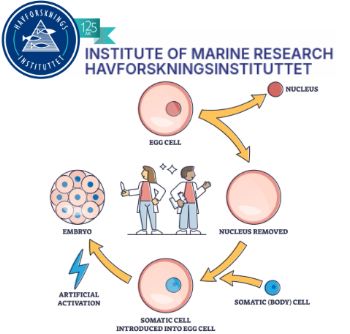
The revolutionary method, currently at the experimental stage, holds promise.Photo: Havforskningsinstituttet/FIS
Surrogacy Breakthrough: Farmed Salmon Could Help Preserve Wild Populations
 NORWAY
Thursday, November 27, 2025, 06:30 (GMT + 9)
Sterile Atlantic Salmon Used as ‘Surrogates’ to Produce Wild Salmon Offspring, Offering Hope for Endangered Species.
 FIS Seafood Media(1).png) A groundbreaking form of "surrogacy" is being explored in Norway, where scientists have successfully used sterile farmed salmon to produce thousands of wild salmon offspring. This report comes from Beate Hoddevik of the Norwegian Institute of Marine Research (Havforskningsinstituttet). The revolutionary method, currently at the experimental stage, holds promise for preserving endangered fish populations and improving aquaculture. A groundbreaking form of "surrogacy" is being explored in Norway, where scientists have successfully used sterile farmed salmon to produce thousands of wild salmon offspring. This report comes from Beate Hoddevik of the Norwegian Institute of Marine Research (Havforskningsinstituttet). The revolutionary method, currently at the experimental stage, holds promise for preserving endangered fish populations and improving aquaculture.
"This is a form of surrogacy," explains marine scientist Lene Kleppe from the Norwegian Institute of Marine Research (Havforskningsinstituttet)."We extract germline stem cells from selected individuals and transfer them to other individuals, that is, to surrogates, who can then have offspring.”
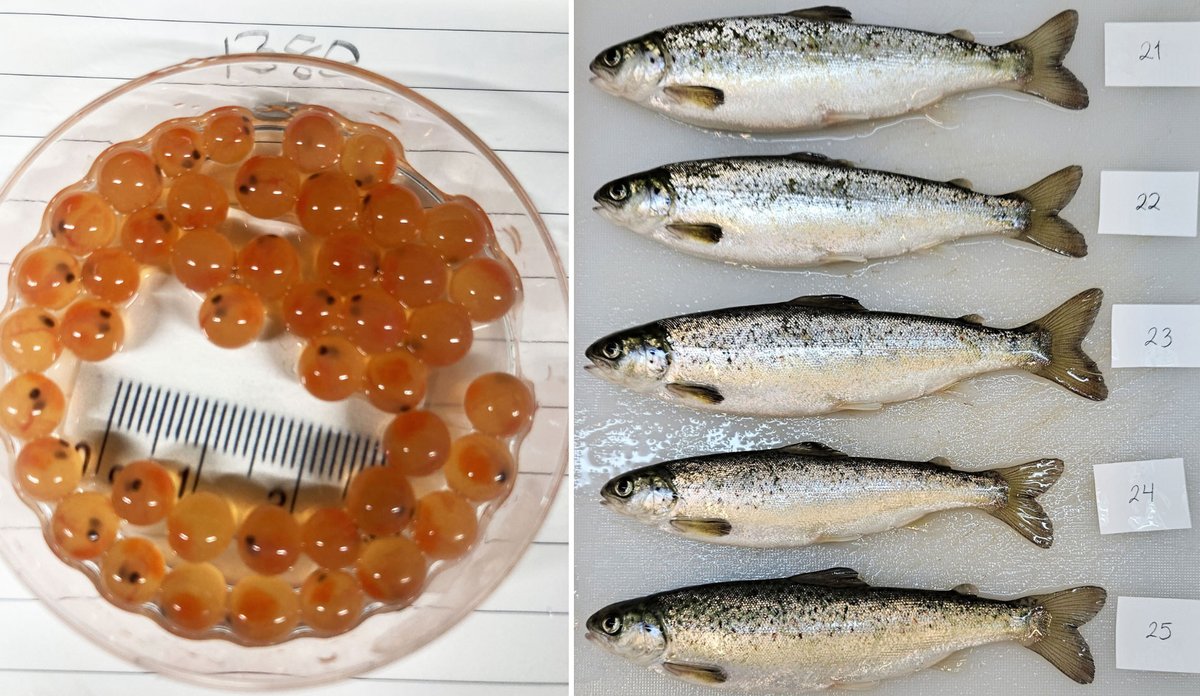
Salmon eggs where you can clearly see the eyes of the fish larvae next to 10-month-old salmon. These are the offspring of a surrogate fish that has had gametes inserted from a donor. Photographer: Tom J. Hansen (fish eggs) / Diego Crespo (fish) / Institute of Marine Research
Technical Data & Experimental Success
The core of the technique involves retrieving germline stem cells —the progenitor cells that develop into eggs or sperm—from a donor fish and injecting them into a sterile recipient, or surrogate, while it is still a fry.
Kleppe confirms: "We extracted germline stem cells from a single fish. We then injected them into both female and male salmon. There, the cells developed into either eggs or sperm, depending on the sex of the fish they were transferred to."
-
Surrogate Fish: The surrogate fish used in the Institute of Marine Research experiment were rendered sterile—referred to as triploid—through a pressure treatment of the eggs. This means they are biologically incapable of producing their own functional eggs or sperm, ensuring that any offspring produced carry the genetic material of the donor.
"This fish does not produce functional eggs or sperm cells, and therefore would not have offspring if it did not receive the donor cells," says Kleppe.
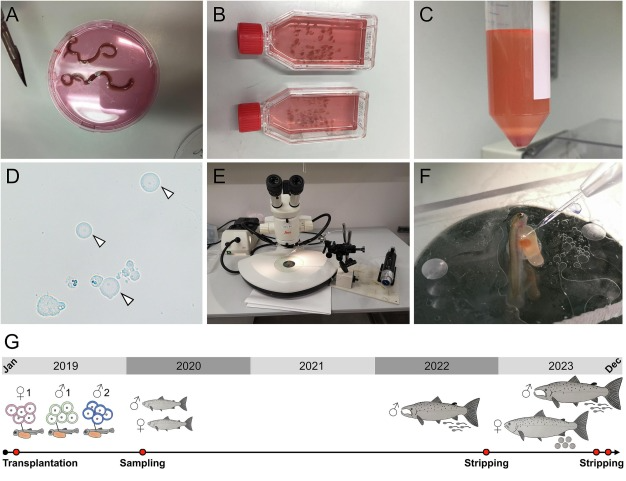
Schematic representation and timeline of the experimental set-up. (A-F) Gonad tissue (A) was collected from one immature female and two immature male Atlantic salmon and subjected to enzymatic dissociation (B). In A, panel shows testis tissue as an example. Upon enzymatic digestion, tissue remnants and isolated gonadal cells were washed and pelleted (C), and – after filtration – the resultant cell suspensions subsequently examined and counted using a microscope (D). In D, presumptive germline stem cells are indicated by white arrowheads. Gonadal cells were then injected into the peritoneal cavity of sterile triploid Atlantic salmon hatchlings (E-F). (G) Timeline of the experiment showing approximate dates for transplantation, an intermediate sampling and stripping of mature male and female surrogates in November 2022 and November/December 2023.
Kleppe adds: "Then we avoid the immune system attacking the unknown cells, and they become part of the fish."
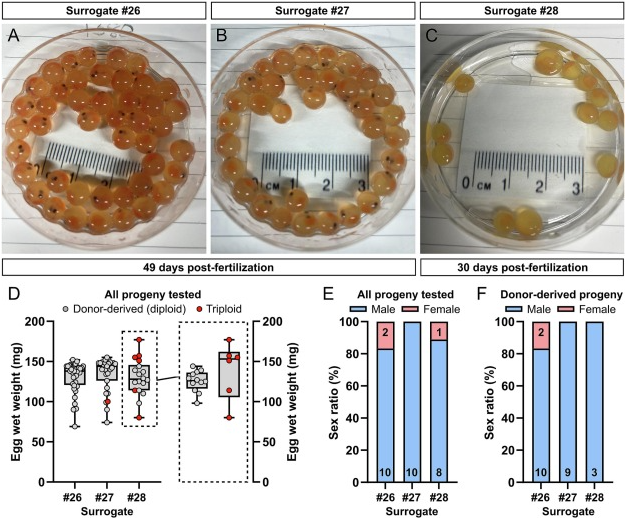
Evaluation of the progeny produced by female surrogates in November 2023. (A-C) Representative photographs showing developing embryos at the eyed stage derived from cross-fertilization of eggs produced by female surrogates #26-#28 and sperm from a standard diploid male on November 3rd (A and B; 49 days post-fertilization) and November 22nd (C; 30 days post-fertilization) 2023. All photographs were taken on December 22nd 2023. Note the varying embryo sizes in all three crosses, noticeable in panel C. (D) Wet weight measurement of eyed eggs produced from surrogates #26-#28 (see Supplementary Table 3 for individual data on wet weight). Grey and red dots indicate diploid (donor-derived) and triploid (surrogate-derived) progeny, respectively. Data are shown as mean ± SEM (n = 18–42). In surrogate #28, the inset shows weight values from diploid and triploid eyed eggs split in independent bars. (E-F) Sex ratio of the progeny produced by surrogates #26-#28, at the eyed stage. Sex ratios of all progeny tested (E) and confirmed donor-derived progeny (F) are shown (see Supplementary Table 3 for individual data on microsatellites). The exact number of samples examined are shown within the bars. (For interpretation of the references to colour in this figure legend, the reader is referred to the web version of this article.)
Global Context and Conservation Potential
While this is the first time the method has been tested on Atlantic salmon in Norway, the technique was originally developed many years ago in Japan.
“The method was developed in Japan many years ago,” says Kleppe.
The primary motivation behind the method is to find a solution to preserve endangered fish species and to create a genetic "gene bank."
"In a reduced population, the genetic material may be small, so it can be challenging to ensure that future generations have enough genetic variation," says Kleppe.
Kleppe notes an example from Japan: "In Japan, for example, a small fish in the mackerel family has been used as a surrogate to produce sperm for the significantly larger bluefin tuna."
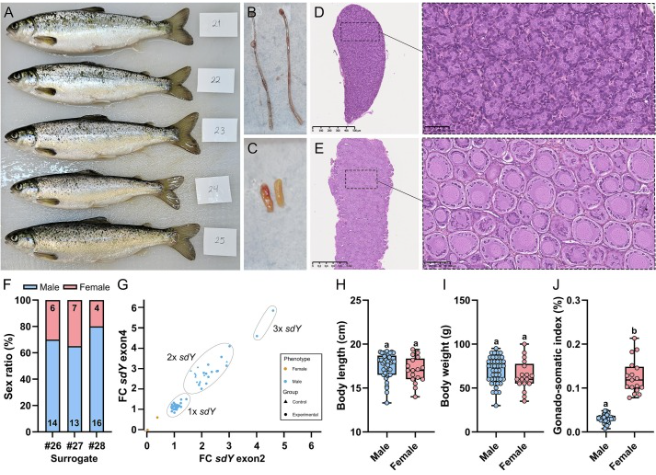
Body metrics and sex ratio of the donor-derived F1 progeny generated by female surrogates. (A-C) Representative external appearance (A), gross gonad morphology (B and C) and corresponding histological images (D and E) of the offspring produced by female surrogates #26-#28, at 10 months of age. (F) Sex ratios of the progeny sampled from the three independent crosses. The exact number of juvenile fish examined are shown within the bars. (G) Real time PCR based fold change (FC) values for sdY exon2 (X-axis) and exon4 amplicons (Y-axis). XY and YY control and experimental males (solid blue triangles and dots, respectively) are distributed according to the sdY dose present in their genome. Females with residual amplification are shown as solid orange dots. (H-J) Comparison of body length (H), weight (I) and gonado-somatic index (J) in the F1 offspring combined by sex. Data are shown as mean ± SEM (n = 17–43). Different lowercase letters denote statistical differences between the groups (p < .05). (For interpretation of the references to colour in this figure legend, the reader is referred to the web version of this article.)
Although the method is currently only in the experimental stage in Norway, it has been put into practical use in Japan.
"They have a project where they actively freeze germline stem cells from various fish species so that they have a 'gene bank' available for possible future use," she says.
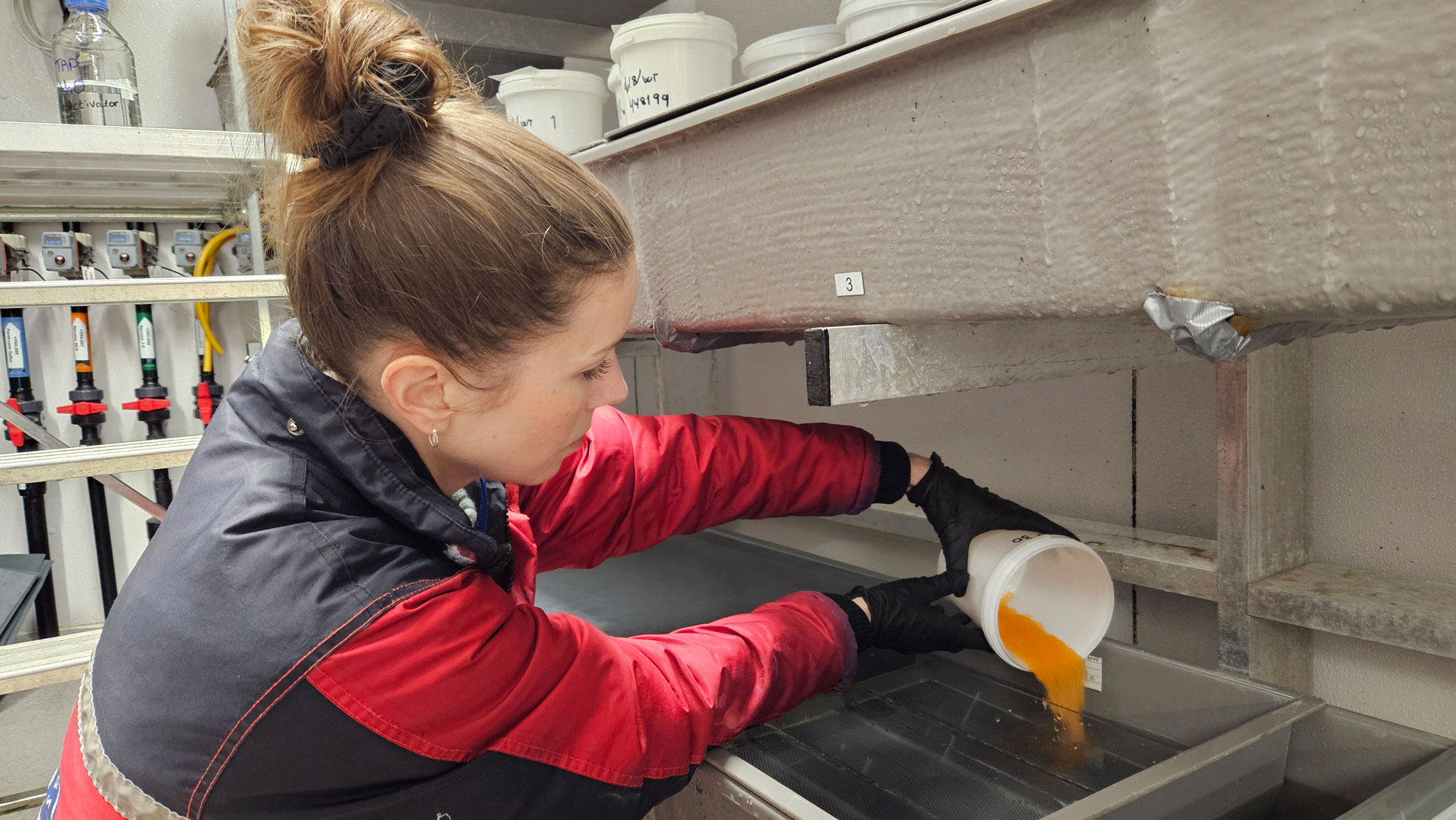
Researcher Lene Kleppe places new eggs in the hatchery. These will be surrogates in a new experiment. Photo: Diego Crespro / Institute of Marine Research
New research projects, including one funded by the Research Council, are underway at HI to further optimize the process.
"So far we have shown that this method can be used with salmon as a donor and surrogate, but there is still a long way to go before it can be used effectively. We will look into this in more detail in the new project," she concludes.
Reference
Kleppe, Lene, et al. "Production of donor-derived Atlantic salmon progeny using allogeneic surrogate broodstock technology." Aquaculture (2025): 742752.
[email protected]
www.seafood.media
|





 Print
Print