|
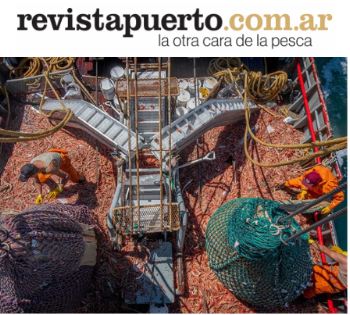
Photo: Revista Puerto/FIS
Red Shrimp Quota Allocation Awaits Political Will to Regulate Argentine Fishery
 ARGENTINA
Tuesday, December 02, 2025, 00:10 (GMT + 9)
The resource, the main driver of the fishing sector, has met the scientific conditions since 2023, but the lack of definition regarding the fleet expanded in the last decade is halting the full application of the Federal Fisheries Law.
The process of allocating quotas for the Argentine shrimp (langostino) is seeking a place on the sector's agenda, according to a report by Karina Fernández of Revista Puerto. Despite having a solid scientific basis, the lack of political decision-making is keeping the implementation of the Individual Transferable Quota (ITQ) regime, established in the 1997 Federal Fisheries Law, in suspense. This regime is a key tool to guarantee the sustainability of the resource.
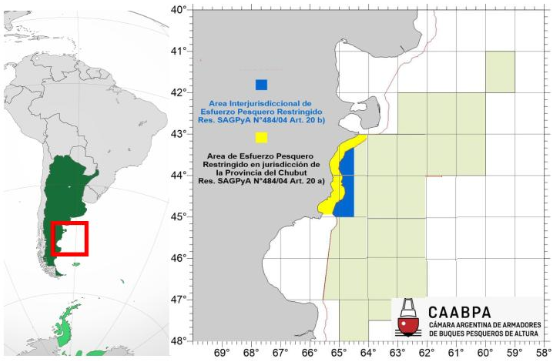
Shrimp fishery management areas that operate with closures and openings (temporal management) but without established catch volumes
The superior objective of the Law is resource sustainability, for which the quota system was adopted. Species such as hake (Merluccius hubbsi), southern blue whiting, Patagonian toothfish, Argentine shortfin squid, and scallop have already been allocated quotas, with hake being the first in a process that concluded in 2009. The shrimp was initially excluded due to the variability of its annual catch.
Base Científica Sólida desde 2023
.png) Esta situación cambió radicalmente en 2023 cuando el INIDEP (Instituto Nacional de Investigación y Desarrollo Pesquero), tras años ininterrumpidos de estudios, logró determinar un volumen de distribución anual estable. La jefa del Programa Langostino, Paula Moriondo, confirmó que el recurso está en condiciones de ser cuotificado y subrayó la importancia de "que la pesquería se ordene" con esta medida. Las proyecciones realizadas, incluso para el año 2025, estimaron una biomasa de alrededor de 220.000 toneladas, lo que se encuentra dentro del promedio histórico, confirmando la posibilidad de establecer un número inicial para el reparto. Esta situación cambió radicalmente en 2023 cuando el INIDEP (Instituto Nacional de Investigación y Desarrollo Pesquero), tras años ininterrumpidos de estudios, logró determinar un volumen de distribución anual estable. La jefa del Programa Langostino, Paula Moriondo, confirmó que el recurso está en condiciones de ser cuotificado y subrayó la importancia de "que la pesquería se ordene" con esta medida. Las proyecciones realizadas, incluso para el año 2025, estimaron una biomasa de alrededor de 220.000 toneladas, lo que se encuentra dentro del promedio histórico, confirmando la posibilidad de establecer un número inicial para el reparto.
The Problem of the Doubled Fleet
The main obstacle to moving forward is the lack of political will to define the status of a large number of vessels that entered the fishery uncontrollably between 2015 and 2022, especially during the Macri administration under the direction of Juan Manuel Bosch (2016–2019).
-
Uncontrolled Expansion: In this period, the shrimp fleet doubled, increasing from about 90 freezer trawlers to more than 200 vessels. At one point, the operation of up to 300 boats on the resource was recorded in 2018.
-
Entry Mechanism: This growth occurred through about fifty reformulations of fishing permits approved by the Federal Fisheries Council (CFP), which granted shrimp quotas under the designation of "catch authorization for non-quota species."
-
Ignored Warnings: Already in 2017, INIDEP warned about the impact of the increase in fishing effort, although their warnings "were not heeded." By 2020, changes in the reproductive period were already observed. The CFP only halted the reformulations in 2022 after verifying the risk posed by continuing to increase the number of vessels.
.jpg)
Photo: Revista Puerto
The Legal "Grey Area" and Catch History
Quota allocation requires defining who will hold the quotas and what share they are entitled to, based on their catch history. The grey area focuses on the reformulated vessels, whose legal status and the volume of catch to be computed are complex:
-
Legal Criterion: Legally, the reformulated vessels could only be credited with the catch quota specified in their permits as “non-quota species.”
-
Irregularities: There were cases of small yellow boats being transformed into large-capacity shrimp vessels or the transformation of permits for surplus species into shrimp catch authorizations.
-
Multiplier Effect: Many vessels greatly exceeded their formal quota by taking advantage of the multiplier effect enabled by the CFP, which allowed fishing up to 150% more given the apparent abundance, thus distorting the actual catch history.
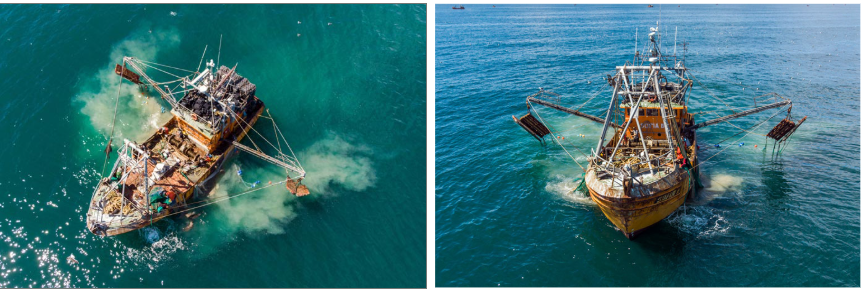
Photo: Revista Puerto/FIS
The reconversion of fleets, such as the Rawson yellow fleet, which transitioned from about 50 wooden coastal vessels to modern, high-capacity ships, is welcome, but it underscores the urgency of regulating fishing effort to avoid jeopardizing the sustainability of the resource and the business.
The first step is the political determination of the Federal Fisheries Council to activate the process, define the time period to be considered for catch history, and apply the parameters of Article 27 of the Federal Fisheries Law. Quota allocation, in addition to regulating the fishery and sizing the fleet to the resource's possibilities, would allow for an exit from the unsustainable "Olympic fishing system."
[email protected]
www.seafood.media
|





 Print
Print