|
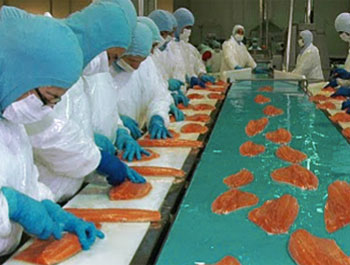
Salmon processing. (Photo: Camanchaca)
Camanchaca reverses loss and reports USD 10 million profits
 CHILE
CHILE
Monday, November 24, 2014, 23:50 (GMT + 9)
Fisheries and aquaculture company Camanchaca obtained a net income of USD 10.1 million as of September 2014, a result that represents a marked increase in comparison with the loss of USD 28 million that it had experienced in the first nine months last year.
As it was reported by the company to the Superintendency of Securities and Insurance (SVS), this recovery was made possible thanks to improved margins in its three business areas totalling USD 47 million.
The salmon and aquaculture divisions increased earnings by USD 25 and USD 3.6 million, respectively. Instead, the fisheries division experienced a loss of USD 1 million as a result of the low fishing activity in the third quarter due to the anchovy ban in the north and the sardine closure in the south of Chile.
Between January and September 2014, the EBITDA before fair value amounted to USD 43 million compared with negative USD 5.4 million that was reported in the same period of 2013.
The income earned by Camanchaca through September reached USD 353 million, 15 per cent more than in the first nine months of 2013. Only in the third quarter the growth was 1.2 per cent, recording revenues of USD 101 million.
The company explained that the accumulated income showed a significant increase in salmon farming areas (21 per cent), other farmed species (13 per cent) and fisheries (6 per cent).
Considering only the quarter, the growth in the fishing areas (23 per cent) and other farmed specimens (24 per cent) stood out.
Camanchaca attributed the good results achieved between January and September this year to a "combination of factors":
- Salmon price rose 21 per cent and Atlantic salmon harvests grew 17 per cent, to 25,000 tonnes;
- Good health requirements for aquaculture facilities as a result of increased sanitary coordination among the companies operating in the same area and using the best caligus bath techniques, reduced costs;
- Improvement in the fishmeal price in the first nine months: the price reached USD 1,632 per tonne compared to USD 1,398 in the fourth quarter of 2013;
- Anchovy catch increased by 11 per cent in the north (89,000 tonnes) despite the longer fishing ban in January and February and the earthquake on 1 April, 2014;
- Significant recovery of the sardine biomass in the south. This made it possible to triple what was captured since last year to date, representing 95 per cent of the annual quota to September, 80,000 tonnes;
- Complete capture of horse mackerel in the southern-central area, reaching 42,000 tonnes. This contributed to the production of 15,000 tonnes of frozen products and 953,000 boxes of canned products;
- The EBITDA of other farmed specimens through September increased from negative USD 2.5 million in 2013 to USD 2 million in 2014 thanks to the cultivation of mussels, whose EBITDA was USD 5 million.
In the US, Camanchaca preferably markets fresh Atlantic salmon fillets, while in Europe it trades frozen Atlantic salmon fillets and portions.
Meanwhile, in Asia -- excluding Japan --, the firm sells whole Atlantic salmon. And in the Japanese market it sells headless whole trout and frozen fillets such as frozen Atlantic salmon fillets.
As for the markets in Latin America, Camanchaca exports whole fresh Atlantic salmon to Brazil and frozen Atlantic salmon fillets to other countries in the region.
Related article:
- Camanchaca obtains USD 9.3 million in H1
By Analia Murias
[email protected]
www.seafood.media
|
|





 Print
Print