IN BRIEF - Boze Mackerel Season Begins: Himeji & Setouchi Autumn Gourmet Fair Opens in Tokyo
JAPAN
Tuesday, November 03, 2026
Shinjuku, Tokyo – The Himeji Tourism and Convention Bureau has launched the "Boze Mackerel Season Begins! Himeji & Setouchi Autumn Gourmet Fair" at the editor's fav Rurubu Kitchen restaurant in Shinjuku.
The limited-time promotional campaign runs from November 1 through November 28, 2026, coinciding with the official opening of the harvest season for the premium branded mackerel "Boze Saba" (Scomber japonicus).
Cultivated using specialized aquaculture techniques from wild seedstock in the Seto Inland Sea, Boze Saba is recognized in the Japanese market for its balanced fat content and exceptional freshness suitable for raw consumption. The event menu highlights raw preparations including sashimi and shabu-shabu, alongside regional agricultural specialties such as Yasutomi yuzu, Himeji lotus root, and a curated selection of six local sake labels from the Harima region.
The initiative aims to expand the commercial footprint of regional culinary goods in the greater Tokyo metropolitan area while promoting seasonal tourism and direct distribution channels for fisheries in Himeji and the Setouchi basin.
The city of Busan announced that the 24th Busan International Fisheries Expo (BISFE 2026) will be held from April 4 to 6 at Hall 1 of BEXCO, located in Haeundae-gu.
Recognized as the region's leading professional trade show for the sector, the exhibition spans seafood, equipment, smart aquaculture, and marine biotechnology.
The event is organized by the Busan Metropolitan Government, co-managed by BEXCO and the Korea Fisheries Trade Association, and sponsored by the Ministry of Oceans and Fisheries, the Ministry of Trade, Industry and Energy, and the Ministry of Food and Drug Safety. Internationally certified by the Global Association of the Exhibition Industry (UFI) since 2008, this edition will bring together 506 companies from 32 countries across 1,300 booths. Overseas attendance will hit a record high of 162 firms from 31 nations, welcoming first-time delegations from Finland, the Netherlands, Argentina, the United Arab Emirates, Saudi Arabia, Taiwan, Germany, and
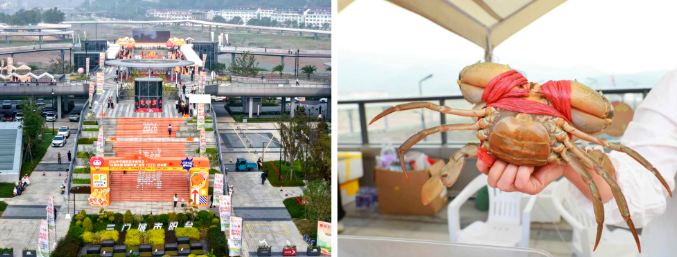
Sanmen Bay, Taizhou – The 2026 China Farmers' Harvest Festival opened on October 31 in Sanmen County, Zhejiang Province, highlighting the region's transition from seasonal yields to an industrialized, multi-sector production model
Known as a premier hub for marine aquaculture, Sanmen currently holds 11 national geographical indication agricultural products and maintains three specialized supply chains valued at over 1 billion yuan (US$ 140 million) each.
The opening ceremony marked the debut of the fifth-generation "Yongtai No. 1" mud crab seedlings (Scylla paramamosain). New aquaculture research confirmed substantial operational gains for the strain: a survival rate increase of up to 37% under low-salinity conditions, a 17% weight gain, and factory-scale overwintering survival rates surpassing 70%.
These developments resolve longstanding bottlenecks in controlled recirculating systems and facility-based crab farming. Backed by technological scaling, Sanmen’s mud crab sector—now assessed at a brand value of 4.8 billion yuan (US$ 672 million)—continues to strengthen its domestic market footprint through sustainable, closed-cycle cultivation.
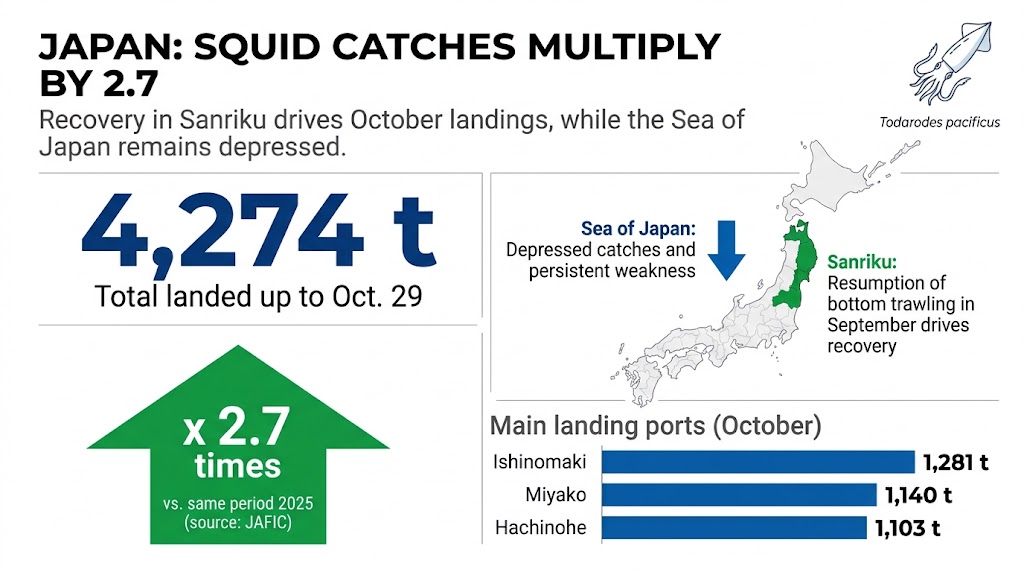
Japanese flying squid landings rebound sharply in October fueled by offshore operations in the Sanriku region, while catches in the Sea of Japan remain depressed.
Landings of Japanese flying squid (Todarodes pacificus) showed a notable recovery in October, driven by fishing activity in the Sanriku region, while catches in the Sea of Japan continue to remain depressed.
According to preliminary data from the Japan Fisheries Information Service Center (JAFIC), the country's major ports landed 4,274 metric tons of fresh squid through October 29, representing 2.7 times the volume recorded during the same period in 2025.
Ishinomaki led port landings with 1,281 metric tons, followed by Miyako (1,140 metric tons) and Hachinohe (1,103 metric tons).
The rebound coincides with the resumption of bottom trawl operations in Sanriku waters in September, where catches have improved considerably.
However, the persistent weakness of the fishery in the Sea of Japan highlights significant regional disparities in resource availability, carrying direct implications for the raw material supply of the Japanese processing industry.
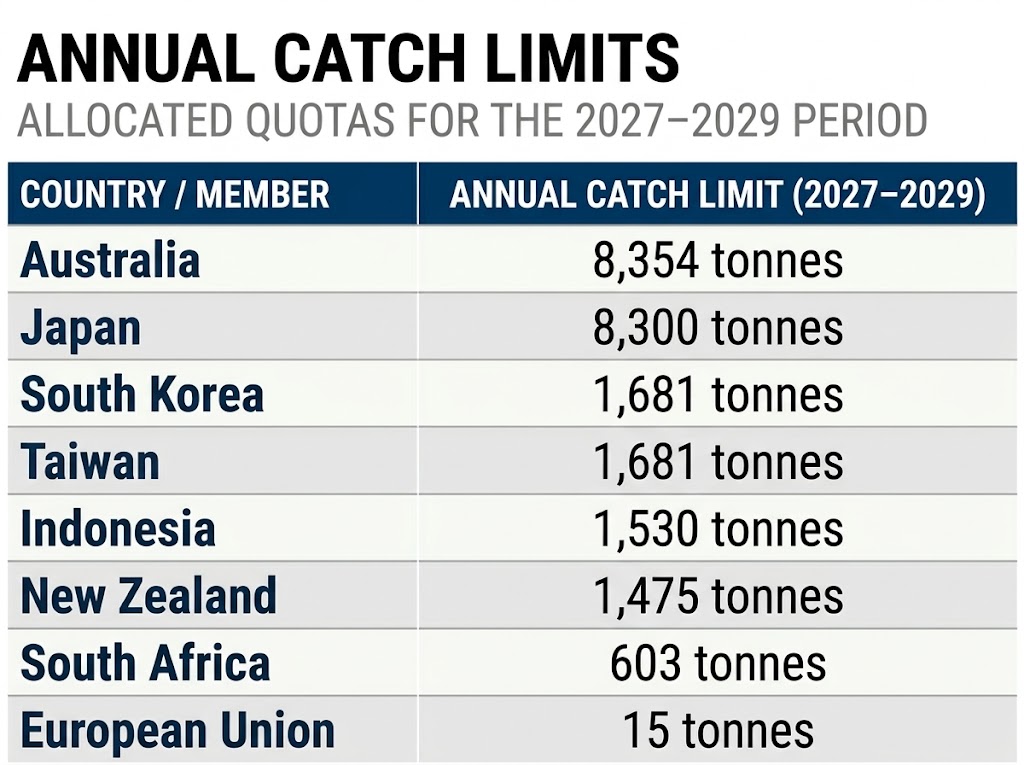
The Extended Commission formally concluded its triennial agreements, raising the fishery's global quota by 3,000 tonnes over the previous cycle and establishing allocations among member countries.
The Commission for the Conservation of Southern Bluefin Tuna (CCSBT) electronically concluded the official report of its 33rd Annual Meeting (CCSBT 33) on October 30, 2026, formalizing a significant increase in global quotas for the next three years.
The Extended Commission determined a new Total Allowable Catch (TAC) of 23,647 tonnes annually for southern bluefin tuna (Thunnus maccoyii) across the 2027–2029 block, representing a rise from the 20,647 tonnes authorized in the previous cycle.
Beijing — China and Norway have signed a sanitary protocol unifying inspection and quarantine requirements for the export of wild-caught seafood to the Chinese market. The agreement will expedite registration and market access for previously unauthorized species, including sea cucumbers, groupers, and wolffish.
Norwegian Minister of Fisheries, Marianne Sivertsen Næss, highlighted that this institutional framework will create new commercial opportunities and foster bilateral cooperation focused on marine ecosystem sustainability.
According to data from the Norwegian Seafood Council, China solidified its position in 2026 as Norway's second-largest export market. Between January and September, shipments reached 158,230 metric tons valued at NOK 11.69 billion (US$ 1.16 billion / approx. 8.4 billion yuan), marking year-on-year increases of 15% in volume and 26% in value.
The council's China director, Bi Siming, affirmed the long-term growth potential of this strategic partnership to meet evolving demand from local consumers.
Norwegian aquaculture producer Andfjord Salmon Group notified on October 30 the conditional exercise of the voluntary call option for its senior secured bond ANDF01, with maturity set for 2028.
The completion of the transaction is subject to the final settlement of a new senior secured bond placement of NOK 1,250 million (US$ 115 million), formally closed on October 27.
According to the company, the proceeds from the new issuance will be allocated to fully refinance the existing bond, fund a debt service reserve account, and directly finance Phase 2A buildout at its land-based facility in Kvalnes (Andøya island, Norway), as well as for general corporate purposes.
The full redemption of the ANDF01 bond will be executed once the contractual conditions established under the new financing package are satisfied.
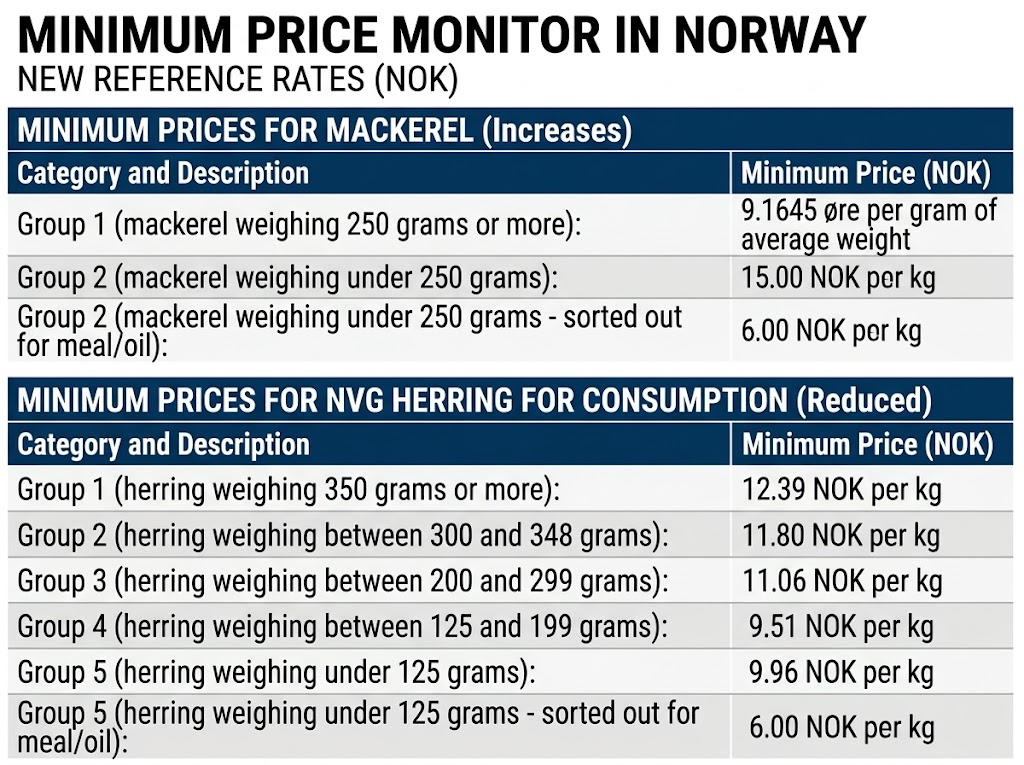
The Norwegian pelagic sales organization Norges Sildesalgslag formalized updated minimum reference auction prices effective Monday, November 2. The adjustment reflects divergent trends across the primary pelagic species landed in the Nordic country.
For Norwegian spring-spawning Atlantic herring (NVG, Clupea harengus) destined for direct human consumption, minimum floor prices across grades from Group 1 to Group 4 fell between 6.3% and 7.5%, while Group 5 remained stable with no change.
In contrast, Atlantic mackerel (Scomber scombrus) weighing 250 grams and above posted an upward trend: its minimum benchmark rose from 9.0288 øre (NOK 0.0903 / US$ 0.0083) to 9.1645 øre (NOK 0.0916 / US$ 0.0084) per gram, representing an increase of approximately 1.5%. Smaller grade sizes and volumes destined for reduction into fishmeal and fish oil remained unchanged.
The revised figures represent mandatory first-sale minimum floor prices rather than spot market transaction prices.
The South Korean trade delegation signs two memorandums of understanding valued at US$ 500,000 to expand its commercial footprint across ASEAN markets.
SINGAPORE — A trade mission comprising seven marine product companies and startups from South Korea's South Gyeongsang (Gyeongnam) province concluded 49 business consultations valued at US$ 12.217 million —approximately KRW 16.3 billion— during a bilateral matchmaking event held on October 28 at the York Hotel Singapore.
The initiative was organized under the official program led by South Korea's Ministry of Oceans and Fisheries and the provincial government, coordinated by the Gyeongnam Technopark Foundation (Gyeongnam TP). During the session, participating companies formalized two memorandums of understanding (MOUs) toward export contracts totaling US$ 500,000 —roughly KRW 670 million—.
The trade mission connected local seafood processors with 13 key Southeast Asian buyers. Featured products included processed fish cakes (eomuk), seafood sauces, semi-dried fish and shellfish, canned craft beer infused with Tongyeong oysters (Crassostrea gigas), value-added flying fish roe (Cheilopogon agoo) and squid (Todarodes pacificus) items, marine-derived bioproducts, and functional konjac jelly made with wakame (Undaria pinnatifida) and kombu (Saccharina japonica).
The Southern Shrimp Alliance (SSA) has filed formal paperwork with the U.S. International Trade Commission (ITC) asking it to weigh in on whether forced labor allegations involving Indian shrimp exporter Nekkanti Sea Foods constitutes an unfair trade practice.
“Forced labor is not a competitive advantage; it’s an inhumane practice that must end,” SSA Executive Director Blake Price said in a release. “Multiple investigations find that Indian shrimp producers cut their costs by exploiting vulnerable populations, who are compelled by debt bondage, restricted movement, and abusive bosses to work in hazardous conditions to make shrimp that is exported to the United States. When the U.S. opens its market to Indian shrimp, we fail those vulnerable workers and allow immoral practices to push ethical producers out of the market.”
Author: Nathan Strout / SeafoodSource | Read the full article here
One of Iceland’s leading salmon farmers has opened up a direct new route into the potentially lucrative Chinese market.
Arnarlax, which is majority owned by Norway’s SalMar, has reported making its first shipment of fresh salmon to China, following the recent introduction of direct flights between Reykjavik and Beijing.
The company said the shipment went well and the fish was in the buyer’s hands just 18 hours after taking off from Keflavík, Iceland’s main international airport.
Arnarlax was already exporting a significant amount of fresh salmon to China, where demand is growing.
Author: Vince McDonagh / Fish Farmer | Read the full article here
Global Commercial Tuna and Ranching Market Overview Worldwide
The closing week of October and opening of November 2026 presents a global tuna market marked by intense logistical and preparatory activity.
In the canning raw material sector, frozen inventory pri...
Copyright 1995 - 2026 Seafood Media Group Ltd.| All Rights Reserved. DISCLAIMER




 JAPAN
.png)
 SOUTH KOREA
.png) Recognized as the region's leading professional trade show for the sector, the exhibition spans seafood, equipment, smart aquaculture, and marine biotechnology.
 CHINA
 WORLDWIDE
.png)
 NORWAY
.png) The completion of the transaction is subject to the final settlement of a new senior secured bond placement of NOK 1,250 million (US$ 115 million), formally closed on October 27.
 SINGAPORE
.png)
 UNITED STATES
 The Southern Shrimp Alliance (SSA) has filed formal paperwork with the U.S. International Trade Commission (ITC) asking it to weigh in on whether forced labor allegations involving Indian shrimp exporter Nekkanti Sea Foods constitutes an unfair trade practice.
.png) Arnarlax