|
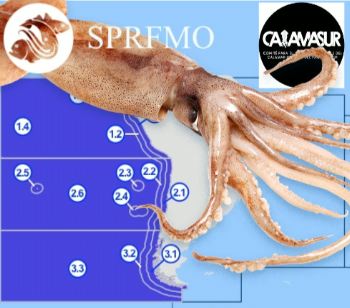
Photo: Stockfile/FIS
The voracious Chinese demand for squid in South American waters
 ECUADOR
Thursday, February 09, 2023, 20:00 (GMT + 9)
The following is an excerpt from an article published by Ojo Publico:
Tomorrow the convention of the South Pacific Regional Fisheries Management Organization (SPRFMO) begins in Ecuador, which seeks to guarantee the conservation and sustainable use of marine species. This opens the possibility of discussing and establishing measures to protect the giant squid or squid, a species highly pressured by its accelerated global demand, mainly in China. In the last five years alone, between 800,000 tons and 1.16 million tons have been caught. A team from the OjoPúblico Cross-Border Network in alliance with Vistazo Magazine reviewed the proposals that China, Peru and Ecuador will bring to the event. China aspires to maintain its supremacy in fishing in international waters.
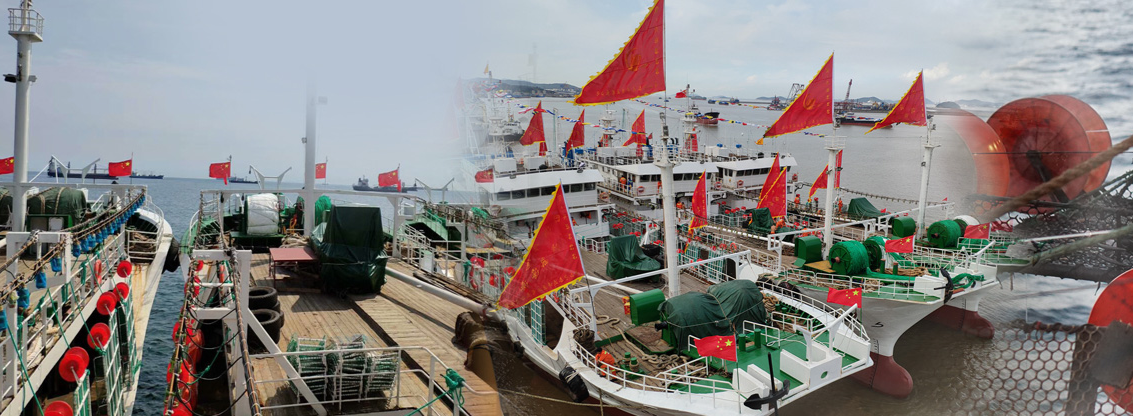
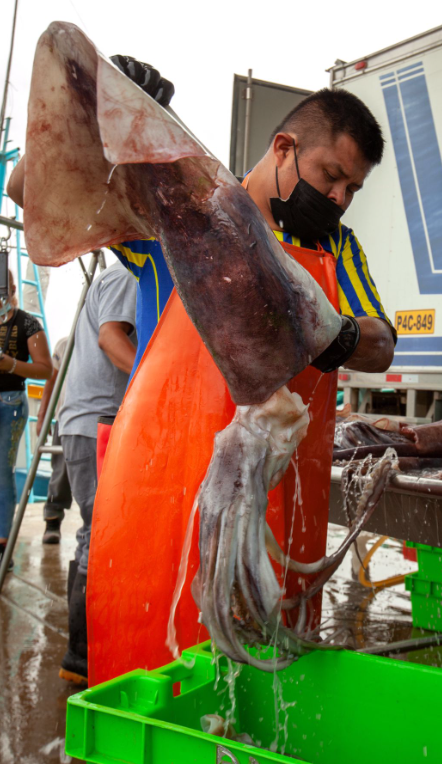 Giant squid, squid or Dosidicus gigas: it measures up to 3 meters in length and can reach 50 kilos in weight. It is one of the main species of the southeastern Pacific Ocean and at the same time it is one of the species with the greatest commercial pressure in the world. Thousands of tons are extracted every month, a large part, from the international waters located off the seas of Ecuador, Peru and Chile. The main player behind that voracious appetite is China: it has a declared fleet of 671 ships. Giant squid, squid or Dosidicus gigas: it measures up to 3 meters in length and can reach 50 kilos in weight. It is one of the main species of the southeastern Pacific Ocean and at the same time it is one of the species with the greatest commercial pressure in the world. Thousands of tons are extracted every month, a large part, from the international waters located off the seas of Ecuador, Peru and Chile. The main player behind that voracious appetite is China: it has a declared fleet of 671 ships.
The squid catch has increased over the last 20 years. In the last five years alone, between 800,000 tons and 1.16 million tons have been caught. This accelerated pressure on the species has alerted experts. And precisely, tomorrow begins an event in Ecuador to discuss measures to guarantee the sustainability of the species: the annual meeting of the Commission of the South Pacific Regional Fisheries Management Organization ( SPRFMO, for its acronym in English) .
Giant squid fishing on the high seas is regulated by the SPRFMO, an international agreement made up of countries with fishing interests whose objective is to guarantee the conservation and sustainable use of the waters located off the coasts of Ecuador, Peru and Chile. In other words, it regulates the extraction of giant squid outside the maritime zone that belongs to the States.
In the midst of the discussion on how to avoid the collapse of the species, one of the countries that has sent its proposal was China. On December 24 of last year, he sent his official proposal on how to limit the expansion of the jigging fleet. This proposal will be discussed during the meeting that will be held between February 7 and 10 in Manta, Ecuador.
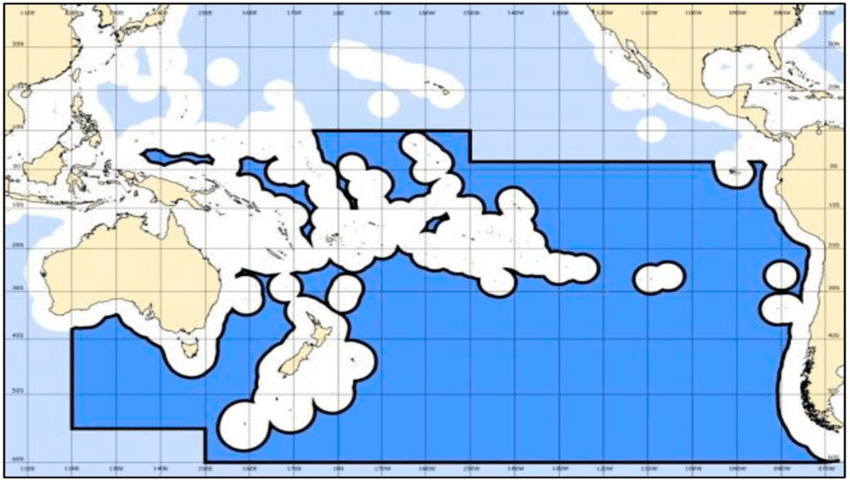
Area-of-jurisdiction-of-the-SPRFMO
The need to protect the species
The SPRFMO brings together 15 countries, including China, Korea, Taiwan, the United States, Peru and Ecuador.
The scientific committee of this organization ratified last year the urgency of limiting the fishing effort and stopping the growth of the Chinese fleet, which concentrates more than 90% of the fishing in international waters.
China's proposal – revised for this report – is that the fleet limit be established based on the number of vessels and tonnage authorized until December 31, 2020. However, for this purpose, the number of registered vessels, instead of the number of operational vessels, as of December 2020.
.jpg)
As of December 2020, China has registered 671 vessels, while Taiwan reported 45, South Korea 30. Under these standards, the Chinese fleet and extraction capacity have no counterweight.
Ulises Munaylla, a Peruvian biologist and former member of the SPRFMO scientific committee, explains that "the number of operational vessels" should have been considered, which in the case of China is 557, since with the 671 registered "the effort would not be limited, rather, the possible overexploitation of the resource would continue to be allowed”.
The scientific committee also recommended that coastal States that have not developed the jumbo squid fishery should do so in a regulated manner.
The biologist questions the lack of coordination of the neighboring countries to achieve a joint position that defends the interests of the coastal States. The most significant expression of the absent regional vision is that Peru and Ecuador have presented different proposals for this SPRFMO meeting.
What do the proposals from Peru and Ecuador say?
Ecuador plans to regulate the transfer of squid from one vessel to another on the high seas (so that it can be processed, without reaching a port) and progressively increase the number of observers on vessels that extract resources on the high seas. Currently only 5% of vessels have observers.
This proposal recommends that by the year 2026, 30% of vessels with a length greater than 24 meters must have at least one qualified observer to collect data. This percentage –according to the approach– should increase from 2024 (10%) and 2025 (20%).
 “Most of the vessels that operate in waters adjacent to the exclusive economic zone of the States of the region are registered with the SPRFMO and, therefore, authorized. However, since there are no complementary regulations for the fishery at the international level, the increase in the number of vessels has not been regulated," said the Vice Minister of Aquaculture and Fisheries of Ecuador, Andrés Arens. “Most of the vessels that operate in waters adjacent to the exclusive economic zone of the States of the region are registered with the SPRFMO and, therefore, authorized. However, since there are no complementary regulations for the fishery at the international level, the increase in the number of vessels has not been regulated," said the Vice Minister of Aquaculture and Fisheries of Ecuador, Andrés Arens.
According to the vice minister, "the greatest risk detected so far has been the density of the foreign fleet, whose light and night fishing methods scare away schools of other species in the region, such as tuna." And in that sense, he considers that "the only way to have real information on the catch record is through the implementation of a great observer program."
However, China is reluctant to increase a larger number of observers.
The situation in Peru
Squid fishing in Peru is considered the second most important fishery, only surpassed by anchovy. In 2021, this country exported 370,889 tons, 30% more than the previous year, very close to the historical peak of 2019, when it reached a total of 382,469 tons. The main destination of everything extracted was China.
Adding up what is extracted in both international and national waters, Peru and China almost equal the amount of annual squid fishing. This despite the fact that there is a huge difference between the two fleets: the Peruvian fleet was made up in 2022 of 4,248 artisanal vessels that fish in national waters, and the Chinese fleet, of 527 industrial vessels (in 2021), that is, vessels with a capacity of very superior winery, which they catch in international waters.
 Descargar los datos Creado con Datawrapper-ojo-publico_com-2023_02_09-08_14_29.jpg)
Giant squid fishing evolution in the South Pacific. Source: South Pacific Regional Fisheries Management Organization (RFMO-PS) Download the data Created with Datawrapper
The regulation of squid capture in Peruvian national waters is the responsibility of the Ministry of Production (Produce).
Peru has established an annual quota for the catch within its 200 nautical miles. The quota normally fluctuates around half a million tons per year. This is defined by the Peruvian Sea Institute (Imarpe), Produce's scientific entity, which evaluates and issues a report on the situation of the species and its fishing prospects for the following year.
The great challenge of the Peruvian fishery is to enter international waters. As of January 2023, only six artisanal vessels, with a hold capacity of no more than 26 cubic meters, were registered with the OROP-PS, that is, only those could carry out squid fishing on the high seas.
 Descargar los datos Creado con Datawrapperojo-publico_com-2023_02_09-08_15_14.jpg)
Giant squid catches in the South Pacific by vessel origin. Source: South Pacific Regional Fisheries Management Organization (RFMO-PS) Download the data Created with Datawrapper
With that tiny number of small vessels, if a quota were established based on the historical fishing record and the fleet was maintained, as suggested by the Chinese proposal sent to the SPRFMO, Peru would have a lot to lose in the face of the powerful fleet China, since it would take into account what was caught in international waters, not in national ones.
However, for the next meeting to be held in Ecuador, Peru has not presented any proposal in this regard. The only initiative of the Peruvian government is related to the observers on board.
 Descargar los datos Creado con Datawrapper-ojo-publico_com-2023_02_09-08_16_00.jpg)
Squid capture in SRPFMO international waters. Source: South Pacific Regional Fisheries Management Organization (RFMO-PS) Download the data Created with Datawrapper
The proposal proposes that until January 1, 2026, vessels of no more than 15 meters in length “from developing states that have extraordinary difficulties in accommodation and security to have an observer on board be allowed to use a monitoring approach alternative scientific, that collects data equivalent to those provided”.
The proposal adds that this does not mean that all ships have to use this alternative mechanism. (continues...)
Author/Source : Maria Belén Arroyo, Alejandro Pérez, Magali Estrada, Gianfranco Huamán, Franklin Vega / Ojo Publico | Read the full article by clicking the link here
[email protected]
www.seafood.media
|





 Print
Print