




It is important to note that despite the incorporation of these new vessels into INIDEP, the objective upheld by Director Otto Christian Wöhler of improving the quality and quantity of research has not been achieved.
The ideal average annual days for a Fisheries Research Vessel in the Exclusive Economic Zone and beyond 200 nautical miles, according to international standards (FAO, CCAMLR, ICES) and INIDEP’s own historical planning and that of comparable countries (Uruguay, Chile, Norway, New Zealand), for a modern research vessel, should range between 220 and 280 days per year to be considered optimal and cost-effective. This range is used by scientific bodies and funders (IDB, UNDP, GEF) when evaluating projects. However, the actual average for INIDEP’s entire fleet (2018–2025) is 170–190 days/year, that is, vessels operate at 65–75% of scientific and sustainable fisheries management standards. One cannot place one of the most important Research Institutes in the world in the hands of incapable people.
.png)
.png)
Source: FAO. Click on the image to enlarge it
Moreover, the objective that even led to the violation of existing legislation regarding national shipbuilding was not met.
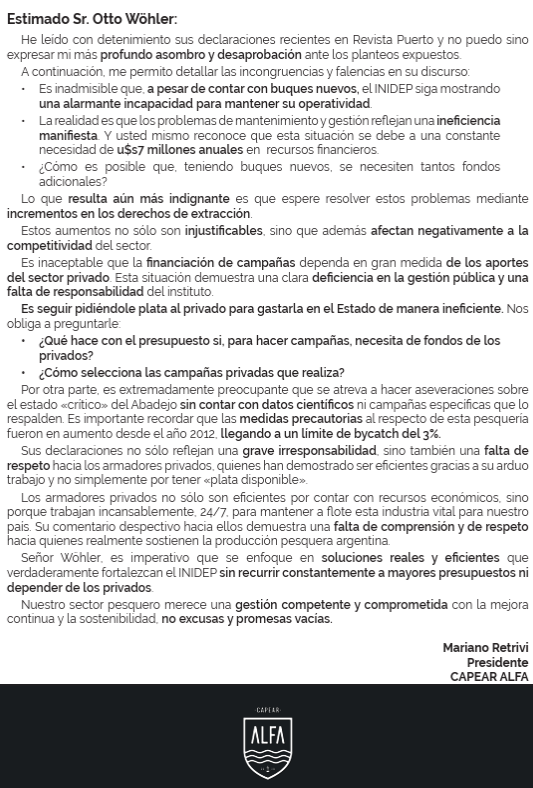
In this regard, it is interesting to transcribe part of the note sent by the President of CAPEAR ALFA, Mariano Retrivi, to Director Otto Wöhler:
“I have read your recent statements in Revista Puerto carefully and cannot help but express my deepest astonishment and disapproval (…) It is inadmissible that, despite having new vessels, INIDEP continues to show an alarming inability to maintain its operability. The reality is that maintenance and management problems reflect a manifest inefficiency, and you yourself acknowledge that this situation is due to a constant need for USD 7 million annually in financial resources.
.png)
How is it possible—continues Retrevi—that, having new vessels, so many additional funds are needed? What is even more outrageous is that you expect to solve these problems through increases in extraction fees (…) It is unacceptable that the financing of campaigns depends to a large extent on contributions from the private sector. This situation demonstrates a clear deficiency in public management and a lack of responsibility on the part of the Institute. It is continuing to ask the private sector for money to spend it inefficiently within the State. It forces us to ask you: What do you do with the budget, if, yes, to carry out campaigns, you need funds from private parties? (…) Your statements not only reflect serious irresponsibility, but also a lack of respect toward private shipowners, who have proven to be efficient thanks to their hard work and not simply because they have ‘money available’ (…) Your disparaging comment toward businesspeople shows a lack of understanding and respect for those who truly sustain Argentine fishing production. Mr. Wöhler, it is imperative that you focus on real and efficient solutions that truly strengthen INIDEP without constantly resorting to larger budgets or depending on private parties. Our fishing sector deserves competent management committed to continuous improvement and sustainability, not excuses and empty promises.”
For his part, an observer of the tendering process stated to anyone willing to listen:
“In the current situation our country is experiencing, to propose a tender of this magnitude shortly before the end of the government; considering that the current INIDEP authorities have demonstrated their total inability to manage their existing fleet; despite the two new vessels, they were idle for a long time, with technical failures and/or expired certificates, forcing the suspension of various research campaigns.”
Instead—he continues—of importing new vessels that increase external debt and affect local industry, perhaps the most appropriate course would be to “import” efficient officials who know how to manage the existing vessels and have greater patriotism. It is not about importing “state-of-the-art” vessels—which Argentina could have built—but rather about an INIDEP Directorate and Research Directorate that are not very competent.
We understand that when importing the vessels, the significant added value generated by shipbuilding in Argentina and technological dependence were not taken into account; which meant, in addition to a very significant loss, the weakening of national autonomy and sovereignty. It has been a very significant outflow of foreign currency abroad and procedures that the judiciary should investigate more thoroughly, in addition to analyzing the assets of all officials involved in the country and abroad who may have some connection with the construction of these research vessels.
Now, the issue was not limited—very serious as it is—to building the vessels abroad, but rather the then Director of INIDEP went further: “A private shipowner will give efficiency to the management of the vessels” (Pescare, 17/5/2017). Wöhler’s statements are truly unbelievable coming from a public agent whose salary, training, and professional development have been paid by the State since 1980. It sounds like a statement by the Deregulation Minister Federico Sturzenegger; but no, it is a public official who has lived off the State for over thirty years (today forty-six).
.png)
The then Director of INIDEP, Wöhler, trusted “in the project ‘he manages’ to reverse a history marked by technical problems, conflict, and inactivity in recent years”; a project which, in light of the results, has turned out to be a failure, while also violating all existing legislation. The project “he manages” seemed to be outsourcing the management of the vessels, affecting INIDEP crew members and carrying out a covert privatization of an activity that existing legislation reserves for the national State, whose results—as we have said—are below the scientific standard and, although this Director stated at that time (op. cit. 17/5/2017) that personnel were already being hired through ArgenINTA, this is clearly an intermediation—which should be investigated—that precarizes the work of the public employee and their bond with the Institution; and to state that the lack of efficiency in the provisioning and outfitting of research vessels “is resolved with a private shipowner, with the capacity to make quick decisions and give efficiency to vessel management” clearly exposes this Director’s inability to manage public affairs, since by this criterion the next step would be to privatize research and INIDEP itself.
The labor conflicts he refers to are not unilateral but rather proof of the inability to manage research, which necessarily includes in situ study campaigns through the vessels assigned to this task, and for that it is necessary—among other things—to implement salary equalization and the legal instruments needed to have, in a timely manner, the means, supplies, and repairs required for vessel operations. If this Director’s policy were applied, it would be necessary to privatize Aerolíneas Argentinas, hospitals, and every institution that requires a budget and adequate programming.
This method of outsourcing INIDEP vessel operations and referring to the fact that “countries such as the United States, France, Germany, England, and Spain use it” (Karina Fernández, Revista Puerto, 15/5/2027) will obviously increase research costs, since concessionary companies, in addition to covering the full operational costs—including crew salaries under collective agreements—must obtain a profit. In short, what is being proposed is to make research more expensive to compensate for the incapacity of INIDEP’s management and, furthermore, to allow private company personnel access to the research before the Institute’s own authorities, violating Law 24.922 (Art. 13).
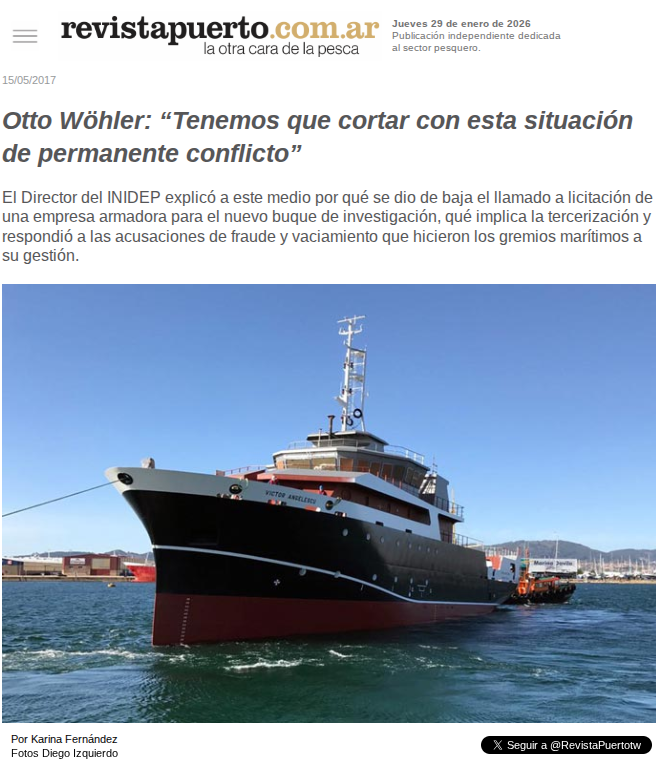
But Wöhler’s privatizing policy has no limits, and it is not enough for him to build research vessels abroad; it would not even suffice for them to be operated by an Argentine shipowner, since according to him they should be associated with a foreign company (op. cit. 15/5/2017):
“The idea is that it be managed by a private company, which according to the tender specifications must be Argentine associated with an international company with experience in research vessels (…) we believe that the experience of companies that already manage research vessels is important for this case; we thought that a local shipowner was not sufficient, perhaps we were wrong, or not, but we structured it that way. We believe that the combination of a local shipowner who knows the environment is very useful, but that it will need the support of an international company, especially in terms of maintenance of scientific equipment (…) the tender was withdrawn when we evaluated the total costs for this year. We had to discard it because it effectively exceeded the budget we currently have available.”
What training does a biologist have to evaluate the operational capacity of an Argentine shipowner? Frankly, an inconsistent assessment that again prejudges the capabilities of Argentine builders, shipowners, and captains.
The contradiction in Wöhler’s position regarding the privatization of the operation of INIDEP’s research vessels is astonishing; since, while he maintains that Argentine research vessels should be operated by foreign shipowners, at the informational meeting he held in 2015 together with the Technical Commission (Mar y Pesca. Noticias Patagónica, 28/12/2015), he stated that the vessels taken as references were the RV Ramón Margalef (Spain, 2011), the RV Ángeles Magariño (Spain, 2011), the RV Solea (Germany, 2004), and the RV Celtic Explorer (Ireland, 2002). All of these vessels are operated by the State. The Margalef and Magariño are operated by the Spanish Institute of Oceanography (IEO) for the Spanish National Research Council (CSIC); the Solea by the Federal Office for Agriculture and Food (BLE) for the scientific monitoring of the Institute of Maritime Fisheries; and the Celtic Explorer by the Marine Institute of Ireland.
This contradictory policy of the then Director of INIDEP is incomprehensible. On the one hand, he promotes the construction of research vessels abroad and, on the other, he promotes that these vessels be operated by companies. On many occasions, INIDEP has used commercial vessels to carry out research. In this privatizing zeal, why not directly tender the research itself, with the operator providing the vessel? We understand that research—even that carried out through vessels—should be conducted by the State; however, it is a true absurdity that the State should buy—using money it does not have—the vessels and have them operated by a third party. Were it not for the fact that we are becoming accustomed to absurdities, we might detect a whiff of a racket.
Moreover, the idea that Otto Wöhler has supported and maintained of creating a National Vessel Agency, which he expressed on that occasion (op. cit. 15/5/2017), is nothing more than shedding responsibility for one of the main pillars of autonomous research. Tomorrow it will be the turn of research offices and every scientific study; in his view, there could be more efficient private laboratories.
.png)
The unions are right. This man would advance proposals that hollow out INIDEP. This type of plan serves to discredit the State and paves the way to privatize everything.
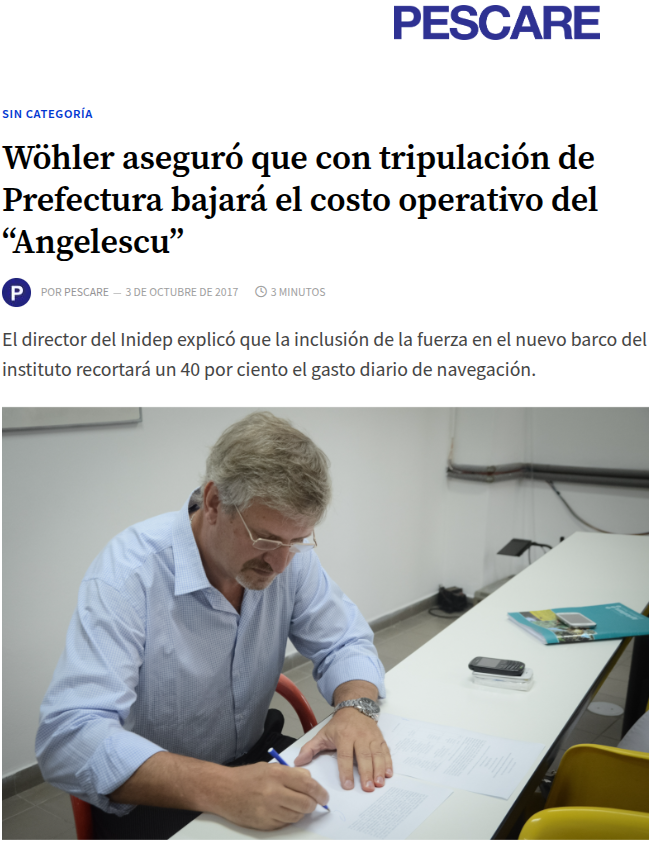
We already referred in a previous article to the idea of reaching agreements with the Coast Guard regarding the operation of research vessels. In terms of reducing costs—under that criterion—the entire Argentine commercial fishing fleet should reach agreements with the Coast Guard and we would militarize the country. It reminds us of times when ministers were divided among the Army, the Navy, and the Air Force according to thematic affinity. The sons and grandsons of fishermen have not inherited a maritime and fishing culture, and thousands of crew members are trained only for one day to be told to militarize because it is cheaper (Pescare, 3/10/2017). In this regard, the Argentine Association of Captains stated: “One thing is navigation and another is fishing. The agreement with the Coast Guard violates the duties of both institutions,” said the organization’s secretary general, Jorge Frías.
Based on the background we have laid out, we have observed a privatizing drive at any cost on the part of the then Director of INIDEP and current Director of Research of INIDEP, Otto Wöhler, a vocation rarely seen in a public official; one who, as we have stated, has been trained and refined by the State.
We do not know whether there will be further articles on this topic; honestly, we have received a great deal of material to continue working with, although we believe the time has come for justice.
.jpg)
Expert in South Atlantic and Fishing.
Former Secretary of State.
President of the Center for Latin American Fishing Studies (CESPEL)
President of the Agustina Lerena Foundation
This article represents the opinion of the signatory. The opinion articles published do not necessarily reflect the editorial position of this medium. Fish Info & Services is an independent medium, open to the opinions of its readers. If you wish to publish, contact us at [email protected]
Related News:

(1).jpg)
.jpg)
 Print
Print