|
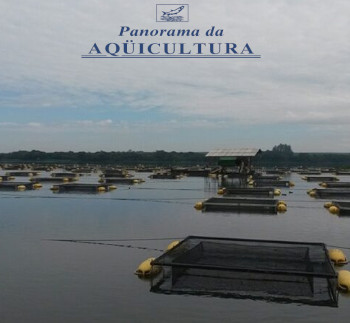
Image: Panorama da Aquicultura / FIS
For the first time, tilapia methane emissions are measured under tropical conditions
 (BRAZIL, 4/6/2023)
The emission of greenhouse gases (GHG) in reservoirs occurs due to physical-chemical processes resulting from the degradation of organic matter and oxidation of chemical compounds
.jpg)
Source: Science Direct. Click here to enlarge.
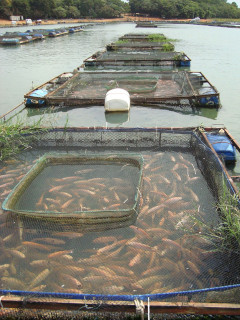
Brazilian researchers carried out a very relevant work for national fish farming. They measured methane emissions in tilapia (Oreochromis niloticus) production in net cages for tropical conditions. The study is important because international thinking usually considers temperate climate conditions in which the so-called ebullitive emissions (by bubbles) from fish are less frequent. The studies were treated in three secondary tributaries that flow into the reservoir of Ilha Solteira (SP): Formoso, Cancan and Ponte Pensada, capable of producing, per year, 800 tons of tilapia, the first one, and 3 thousand tons the other two tributaries. Part of these results were published in the journal Environmental Challenges.
 Approximately 75% of ebullitive emissions (by bubbles) of methane in tilapia productions were recorded in sites with net cages, compared to the other surfaces of the reservoir. However, the bubbles were punctual events and did not occur in the entire area of the net cages. The emission of greenhouse gases (GHG) in reservoirs occurs due to physical-chemical processes resulting from the degradation of organic matter and presentation of chemical compounds in the water column and sediment. Methane is 34 times more potent than carbon dioxide in influencing global warming over a 100-year time horizon. Approximately 75% of ebullitive emissions (by bubbles) of methane in tilapia productions were recorded in sites with net cages, compared to the other surfaces of the reservoir. However, the bubbles were punctual events and did not occur in the entire area of the net cages. The emission of greenhouse gases (GHG) in reservoirs occurs due to physical-chemical processes resulting from the degradation of organic matter and presentation of chemical compounds in the water column and sediment. Methane is 34 times more potent than carbon dioxide in influencing global warming over a 100-year time horizon.
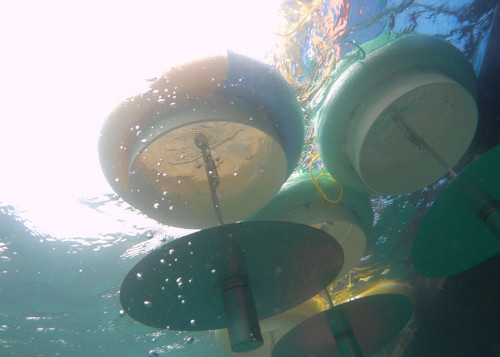
According to Marcelo Gomes da Silva, from the Scholarship Program of the National Council for Scientific and Technological Development (CNPq), little is known about the contribution of fish farming in the processes of emission or removal of GHG in tropical reservoirs. One of the main concerns associated with fish farms is related to the release into the water of considerable organic matter substances, from uneaten food and fish excrement, which can be recorded in GHG. GHG produced in water bodies are transported to the surface mainly by two switches. In diffusive flow, gases formed in sediment and water are transported through the water column to the atmosphere. The ebullitive, originating from bubbles formed in the substrate, is released when water is inhaled or when a bubble overcomes the hydrostatic pressure, crossing the water column and being released into the atmosphere.
Source: Panorama da Aquicultura
For a reliable result, it was necessary to study both transports. Diffusive, despite being common and occurring in the entire reservoir, tends to have lower methane emissions when compared to bubble emission. The study in the Ilha Solteira reservoir showed that the average methane transmission by diffusion was 5 milligrams per square meter per day. On the other hand, the emission of ebullitive methane, which is less frequent, came to emit bubbles of 5,000 to 10,000 milligrams per square meter per day. Studies abroad almost did not evaluate the emission by bubbles because this is a characteristic of tropical reservoirs, in areas with warmer waters, with a lot of available organic matter.
<--Source: Panorama da Aquicultura
-
- Work considered bubble emissions (boiling), common in tropical countries and unusual in international controls.
- The amount of methane released by diffusion is six times greater on top of these productions. The bubble emission is 2,000 times higher.
- The results suggest that the volume of fish production may be an important factor in methane emissions.
- Adequate animal feeding, good management practices and planned strategies for fish farming in net cages are capable of reducing emissions.
For the inclusion of data in national inventories, researchers from tropical areas suggest considering ebullitive emissions. “When we do methane analysis, with modeling to determine this gas flow that leaves the water column into the atmosphere, or using equipment that only measures the atmospheric air above the reservoir, these methods are not able to catch these bubbles”, observes Gomes da Silva.
The great importance of this work is to show that in addition to net cages increasing the emission of greenhouse gas in the form of methane, they greatly increase the ebullitive flow, that is, the number of bubbles and the impact of methane emission. Therefore, the importance of understanding the two transports of gases to the atmosphere.
According to Silva, it was observed that the increase in methane emissions was associated with the tilapia production area. The increase was about six times for diffusive methane and approximately 2000 times for ebullitive emissions, compared to the external areas of the net cages.
 Another important factor to be considered is that there was no significant difference in methane emissions when comparing the locations before and after the net cages. This fact suggests that the effects of fishing production on emissions are restricted to the area of its direct action. The influence of tilapia rearing on methane emissions was restricted to net cage sites, demonstrating that the impact is local and dissipative by the environment. Factors such as high concentrations of carbon and phosphorus in water and sediments have been associated with increased emissions. Therefore, adequate feeding, good management practices and planned strategies for fish farming in net cages will allow the producer to improve productivity and reduce methane emissions. Another important factor to be considered is that there was no significant difference in methane emissions when comparing the locations before and after the net cages. This fact suggests that the effects of fishing production on emissions are restricted to the area of its direct action. The influence of tilapia rearing on methane emissions was restricted to net cage sites, demonstrating that the impact is local and dissipative by the environment. Factors such as high concentrations of carbon and phosphorus in water and sediments have been associated with increased emissions. Therefore, adequate feeding, good management practices and planned strategies for fish farming in net cages will allow the producer to improve productivity and reduce methane emissions.
The scientists point out that the establishment of fish farming in net cages in a tropical reservoir must consider carrying capacity, seasonality and the amount of carbon to minimize methane emissions. “It is worth noting that the limits defined in this study refer to the characteristics of the Ilha Solteira reservoir. Therefore, we suggest that the concentrations of nutrients in the sediment and water be studied for better management of the reservoir and for the selection of new areas for the installation of net-tanks”, ponders Silva.
 “These findings provide valuable information that the rearing of tilapia in net cages in reservoirs may be associated with increased methane emissions, but the impact is restricted to a small area when detected to the total area of the reservoir. This is an important fact to be considered and indicates that fish farming has the potential to be one of the animal production activities with the lowest carbon footprint”, “These findings provide valuable information that the rearing of tilapia in net cages in reservoirs may be associated with increased methane emissions, but the impact is restricted to a small area when detected to the total area of the reservoir. This is an important fact to be considered and indicates that fish farming has the potential to be one of the animal production activities with the lowest carbon footprint”,
explains Paula Packer, general manager of Embrapa Environment and one of the authors of the study.
Water quality
Monitoring water quality is the main strategy for the sustainable management of aquaculture, fundamental for planning activities and expanding production. “The uncontrolled increase in fish farming due to the lack of adequate policies to limit or establish good management practices can be associated with serious environmental problems. Hence the importance of monitoring to ensure the lowest possible environmental impact, helping to mitigate them when necessary, an essential condition to guarantee the sustainability of the sector”, emphasizes Fernanda Sampaio.
Source: Panorama de la Acuicultura. (Translated from the original in Portuguese)
[email protected]
www.seafood.media
Information of the company:
|
Address:
|
Parque Estação Biológica - PqEB s/n°.
|
|
City:
|
Brasília
|
|
State/ZIP:
|
DF (70770-901)
|
|
Country:
|
Brazil
|
|
Phone:
|
+55 61 3448 4433
|
|
Fax:
|
+55 61 3448 4890
|
More about: 
|
|
|
|








 Print
Print
















.jpg)