|
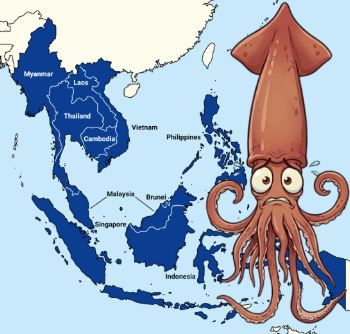
ASEAN nations play active roles in other large RFMOs like IOTC (Indian Ocean) and WCPFC (Western & Central Pacific) but not at the SPRFMO (OROPO-PS)
South Pacific Squid Fishery at a Crossroads: Crisis, Dynamics, and Implications for the ASEAN Region
 (WORLDWIDE, 11/24/2025)
While Chile sees stability, Peru and China face sharp declines in Jumbo Flying Squid catches, prompting calls for urgent management reforms at SPRFMO.
The Jumbo Flying Squid (JFS) (Dosidicus gigas) is one of the most productive and economically vital species in the South Pacific, sustaining thousands of livelihoods and feeding global supply chains. However, the fishery is currently navigating turbulent waters. As a short-lived, highly volatile species that responds dramatically to oceanographic changes like El Niño, the JFS presents a management challenge far more complex than traditional fish stocks.
In the wake of the 12th Scientific Committee meeting of the South Pacific Regional Fisheries Management Organisation (SPRFMO) held in Lima in late 2024, and recent industry workshops organized by CALAMASUR, the divide in fishery fortunes has become stark. This article summarizes key presentations from the international workshop, analyzes the divergent status of Chile, Peru, and China, and outlines the critical economic ripples reaching the ASEAN region.
 Convention area map.png)
Catch Volumes and Notable Fluctuations
JFS catches have been highly divergent in the 2023–2024 period. While Chile has maintained steady growth within its heavily regulated Exclusive Economic Zone (EEZ), Peru and China—heavily dependent on international waters and open-access regimes—have witnessed sharp declines.
According to recent data and reports from Seafood.media (FIS), the 2023–2024 El Niño phenomenon dispersed stocks, causing what Peruvian industry leaders call the "worst crisis in 25 years." The table below highlights the degree of variation:
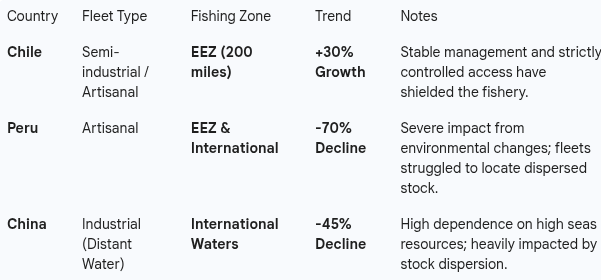
Chile’s impressive 30% growth was driven by stable management in its EEZ, where industrial capture is now largely bycatch and the artisanal sector thrives. (7).jpg) In contrast, Peru’s 70% and China’s 45% declines reflect the extreme sensitivity of JFS to environmental changes and fishing pressure. Alfonso Miranda, President of CALAMASUR, has warned that these figures are a "red alert" regarding the risk of resource collapse without appropriate management measures. In contrast, Peru’s 70% and China’s 45% declines reflect the extreme sensitivity of JFS to environmental changes and fishing pressure. Alfonso Miranda, President of CALAMASUR, has warned that these figures are a "red alert" regarding the risk of resource collapse without appropriate management measures.
Fleet Capacity and Pressure on International Waters
A major source of tension in the JFS fishery lies in the asymmetry of fleet size and structure. China maintains a massive distant-water fleet with superior refrigerated storage capacity, allowing it to stay at sea for months. Peru, despite being the world's largest producer in historical terms, relies on a vast fleet of small coastal vessels.
The following table summarizes the structural differences:
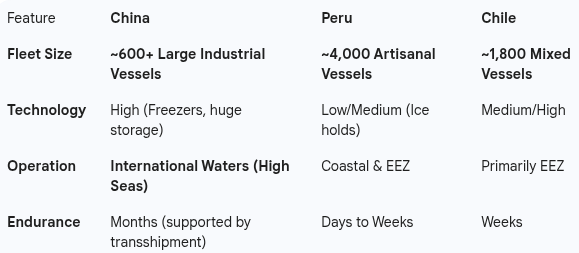
The capacity of its fleet grants China a distinct advantage in offshore fishing, enabling it to pursue migrating stocks into international waters where regulation is weaker. In contrast, Peru’s small fleet has limited range, making it vulnerable when resources migrate away from the coast due to warm waters, as seen during the recent El Niño.
SPRFMO: Central Administration without "Teeth"
The SPRFMO is the body responsible for managing JFS resources in international waters. However, compared to the well-regulated horse mackerel sector, the squid fishery remains what experts call a "quasi-open fishing environment."
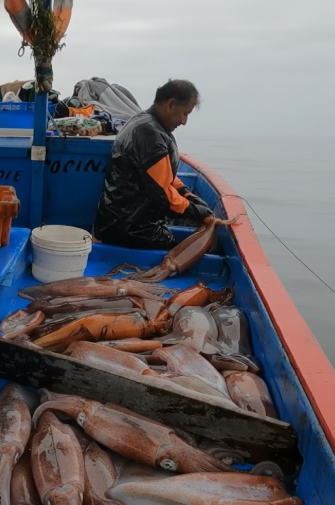
Peruvian artisanal giant squid fisherman -->
Essential management tools are still missing or disputed:
-
No Total Allowable Catch (TAC): unlike other fisheries, there is no global cap on how much squid can be caught.
-
Weak Observer Coverage: While coastal states push for higher human observer coverage, distant water fishing nations have historically opposed binding increases, settling for lower electronic monitoring standards.
-
Data Gaps: There is no standardized stock assessment model agreed upon by all parties.
Despite SPRFMO’s efforts, a recent performance assessment confirms that the squid industry is the organization's weakest managed sector, with an urgent need to complete a science-based governance framework.
Socio-Economic Impact: The Case of Peru and Ecuador
The biological crisis has triggered a social one. In Peru, the 70% decline in production led to massive price swings.
-
Price Volatility: When production drops, prices soar. However, fishermen do not benefit proportionately due to the high operational costs of searching for scarce squid and market uncertainty.
-
Livelihoods at Risk: The majority of the 4,000+ Peruvian vessels are small-scale, family-run operations. The 2024 shortage left thousands of families with reduced income, threatening the social fabric of coastal towns like Paita.
In Ecuador, squid accounts for 10.5% of artisanal fisheries production. While total volume is lower than Peru, the dependence is high. This highlights the need for a suitable management framework that protects small-producing countries from the aggressive extraction of industrial fleets in adjacent international waters.

Chinese Squid jigging fisheries at international waters
Management Progress: A Mixed Picture
South Pacific coastal states have varying levels of regulatory maturity, creating a patchwork of management:
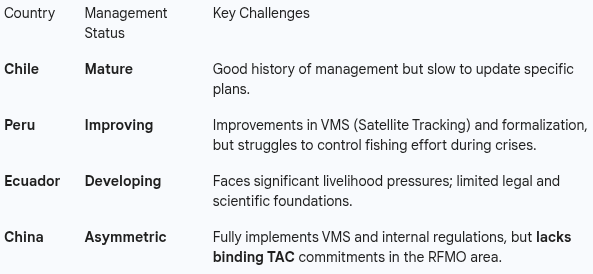
China, despite having internal regulations, operates in international waters where the lack of a binding TAC (Total Allowable Catch) creates a situation of asymmetric responsibility.
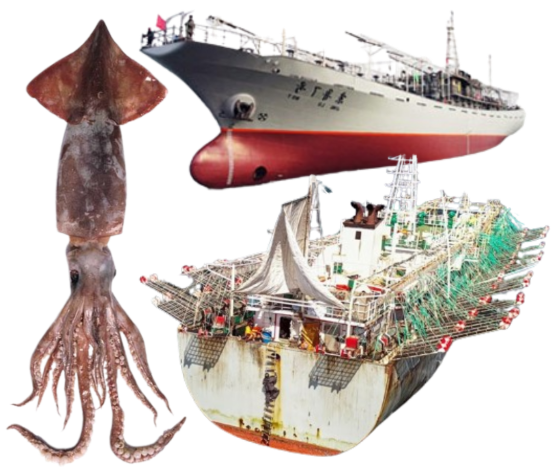
Chinese squid jigger
Specific Implications for the ASEAN Region
The ASEAN region, although not a direct participant in SPRFMO, is deeply affected by these fluctuations.
-
Supply Chain Shock: Vietnam, Thailand, and Malaysia are major seafood processing hubs that depend heavily on raw squid imports from Peru and China. The decline in production has caused raw material prices to increase sharply—Chinese price indices for deep-sea squid rose by over 55% in 2024.
-
Competitiveness: Higher input costs reduce the competitiveness of ASEAN businesses in the global export market, squeezing margins for processors in Samut Sakhon (Thailand) and Mekong Delta (Vietnam).
-
Shared Challenges: The structure of ASEAN fisheries—dominated by small-scale, multi-species vessels—is remarkably similar to that of Peru and Ecuador.

Photo: Zhoushan National Distant Water Fishery Base Construction and Development Group Co., Ltd.
The Lesson for ASEAN: Experience from SPRFMO shows that data transparency, mandatory VMS, and stock valuation models are the core foundations for sustainable management. As ASEAN nations play active roles in other large RFMOs like IOTC (Indian Ocean) and WCPFC (Western & Central Pacific), the global trend toward evidence-based governance will soon impact the region directly. This is the time for ASEAN to proactively strengthen its fisheries management systems to adapt to increasingly high international requirements and secure their own supply chains against global volatility.
[email protected]
www.seafood.media
Information of the company:
|
Address:
|
Level 26 Plimmer Towers, 2-6 Gilmer Terrace (access via Lambton Quay)
|
|
City:
|
Wellington
|
|
Country:
|
New Zealand
|
|
Phone:
|
+64 4 4739579
|
|
E-Mail:
|
[email protected]
|
More about: 
|
|






 Print
Print