|
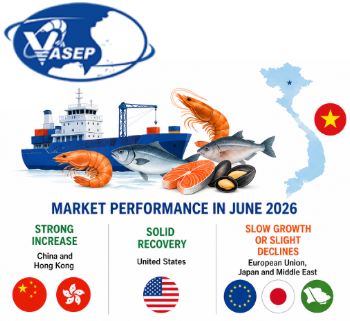
In the first half of 2026, seafood exports not only grew, but also reflected the ability to pivot to new markets.
Vietnam seafood exports reach $5.8 billion in the first half of 2026, but cost and logistics pressures persist
 (VIET NAM, 7/2/2026)
The sector consolidates a 12.8% growth driven by China and market diversification, while global ocean freight rates and trade barriers in the United States and the European Union condition second-half performance.
The seafood sector of Vietnam closed the first half of the year with positive figures. In June 2026, seafood exports reached nearly $1.1 billion, representing a 21.0% increase compared to the same period in 2025. With this result, the cumulative export turnover during the first six months of the year rose to nearly $5.8 billion, consolidating a 12.8% growth.
 FIS Seafood Media(1).jpg)
Exports to China and Hong Kong continued to record a strong surge, while the US market showed a solid recovery in June. Conversely, the European Union, Japan, and the Middle East experienced slow growth or slight declines.
According to reports by Ms. Le Hang, Deputy Secretary General of the Vietnam Association of Seafood Exporters and Producers (VASEP), the growth in the first half of 2026 does not stem solely from a simple recovery in demand. Instead, it reflects the ability of companies to pivot to new markets, adjust their product structures, and better exploit areas with geographical proximity, lower costs, and stable consumer demand. VASEP emphasized that this strategic shift occurs in a context where importers are becoming increasingly cautious: "Orders tend to be shorter, more fragmented, require more competitive prices, and demand stricter controls on quality, certification, traceability, and delivery times."
.png)
Sector Performance by Species
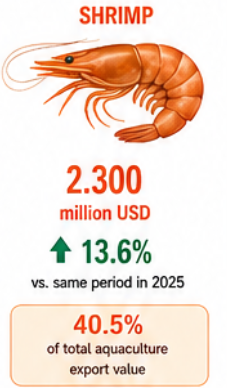 Shrimp remains the largest export group of Vietnam's seafood industry. In June 2026, exports from this sector reached $445.9 million (a 20.7% increase year-on-year). During the first half of the year, they totaled $2.3 billion, a 13.6% increase, representing 40.5% of the country's total seafood export value. This segment is the main driver of overall growth and the decisive factor in achieving annual targets. The first-half performance was strongly supported by China and Hong Kong, especially in lines such as tiger shrimp, lobster, frozen shrimp, and products catering to restaurants and high-end consumer markets. Shrimp remains the largest export group of Vietnam's seafood industry. In June 2026, exports from this sector reached $445.9 million (a 20.7% increase year-on-year). During the first half of the year, they totaled $2.3 billion, a 13.6% increase, representing 40.5% of the country's total seafood export value. This segment is the main driver of overall growth and the decisive factor in achieving annual targets. The first-half performance was strongly supported by China and Hong Kong, especially in lines such as tiger shrimp, lobster, frozen shrimp, and products catering to restaurants and high-end consumer markets.
However, the US market remains a major bottleneck. Despite the general surge in seafood exports to that country in June, the shrimp industry faces intense competition from Ecuador, Indonesia, India, and other suppliers possessing advantages in costs, production scale, and raw materials. Furthermore, risks associated with anti-dumping duties, countervailing duties, SIMP (Seafood Import Monitoring Program), MMPA (Marine Mammal Protection Act), and traceability requirements continue to increase compliance costs for Vietnamese businesses.
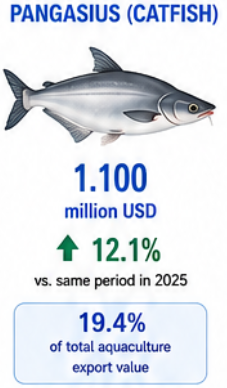 Meanwhile, pangasius catfish maintained its position as the second-largest export pillar. In June 2026, its shipments generated $209.1 million (a 7.7% increase), accumulating $1.1 billion in the first half of the year (a 12.1% increase), equivalent to 19.4% of the total exported value. This progress demonstrates that demand for reasonably priced whitefish remains stable despite spending cuts by consumers. Vietnam's pangasius continues to compete with advantages in price, large supply, processing flexibility, and adaptability to channels such as retail, restaurants, industrial kitchens, and reprocessing. Faced with the price volatility of other whitefish species like cod and pollock, which are affected by supply and trade policies, pangasius increased its competitiveness, although challenges linked to raw material prices, aquaculture feed costs, logistics, and regulations in the US persist. To sustain momentum, the industry is betting on expanding lines of deeply processed products (cut, marinated, packaged, and ready-to-consume). Meanwhile, pangasius catfish maintained its position as the second-largest export pillar. In June 2026, its shipments generated $209.1 million (a 7.7% increase), accumulating $1.1 billion in the first half of the year (a 12.1% increase), equivalent to 19.4% of the total exported value. This progress demonstrates that demand for reasonably priced whitefish remains stable despite spending cuts by consumers. Vietnam's pangasius continues to compete with advantages in price, large supply, processing flexibility, and adaptability to channels such as retail, restaurants, industrial kitchens, and reprocessing. Faced with the price volatility of other whitefish species like cod and pollock, which are affected by supply and trade policies, pangasius increased its competitiveness, although challenges linked to raw material prices, aquaculture feed costs, logistics, and regulations in the US persist. To sustain momentum, the industry is betting on expanding lines of deeply processed products (cut, marinated, packaged, and ready-to-consume).
The group of other fish species (primarily marine fish and some freshwater fish) reached a scale similar to that of pangasius. In June, its exports totaled $198.8 million (+19.8%), while the cumulative first-half figure reached $1.1 billion (+12.0%), contributing 19.3% of the total. Although reflecting the diversification of Vietnam's supply, this marine capture sector faces severe pressures regarding raw material supply and legal fishing certification and traceability demands, such as the European Union's anti-illegal, unreported, and unregulated (IUU) fishing regulations and the US MMPA.
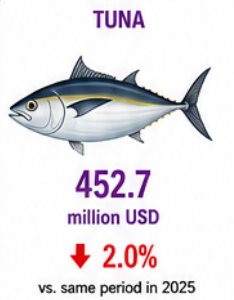
Tuna showed mixed performance. In June 2026, it recorded a recovery with $85.9 million (a 28.0% increase), but the cumulative figure for the first six months stood at $452.7 million, representing a 2.0% decline due to decreases in previous months. This market is conditioned by slow purchasing power, canning costs, and increasing demands for sustainable fishing practices, added to the European Union's logbook controls and electronic traceability systems, which impact customs clearance speeds.
 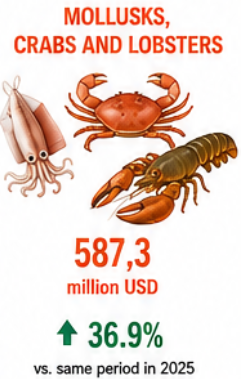
The mollusk, crab, and lobster sectors stood out as bright spots. Exports of squid and octopus in June reached $77.9 million (+26.5%), accumulating $380.2 million in the half-year (+18.8%), driven by Asian markets such as South Korea, Japan, Thailand, and China. Crabs and other crustaceans totaled $45.3 million in June (+55.1%) and $206.2 million in the half-year (+26.2%). Bivalve shellfish grew 77.8% in June ($31.3 million) and 33.1% in the cumulative period ($155.3 million). Other mollusks, on a smaller scale, totaled $6.1 million in the half-year, but recorded an 84.4% increase.
Destination Market Performance
-
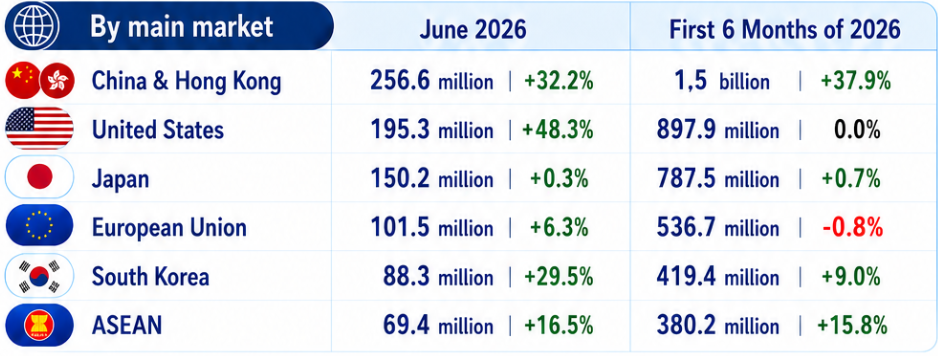
China and Hong Kong: Consolidated as the largest import region and the clearest growth driver. In June, absorbing $256.6 million (+32.2%), they closed the half-year at $1.5 billion, a remarkable 37.9% increase representing 25.8% of Vietnam's total exports, highlighting purchases of shrimp, pangasius, lobster, mollusks, and live and frozen marine products.
-
United States: Registered a 48.3% rebound in June with $195.3 million. However, the cumulative half-year figure stood at $897.9 million, almost identical to the same period last year. This suggests that the June boom is linked to short-term orders, while overall demand remains unstable due to inventory levels, price competition, and technical barriers.
-
Japan: Reached $150.2 million in June (+0.3%) with a cumulative total of $787.5 million (+0.7%). It remains key for shrimp, squid, octopus, tuna, and surimi, but purchasing power recovers slowly due to high food costs and the weak yen.
-
European Union: Invoiced $101.5 million in June (+6.3%), but the cumulative six-month figure fell 0.8%, standing at $536.7 million. The IUU yellow card and certification demands continue to pressure the capture sector.
-
Middle East: Registered $166.6 million in the half-year, equivalent to a slight 0.1% drop.
Source: VASEP | Click on the image to enlarge it
On the positive side, the market diversification strategy yielded visible results in other regions: South Korea reached $419.4 million (+9.0%); the Association of Southeast Asian Nations (ASEAN) totaled $380.2 million (+15.8%); and the rest of the markets totaled $1.1 billion (+17.1%). Nearby destinations with less volatile trade policies helped offset slowdowns in the Western bloc and Japan.
The Logistics Challenge of the Second Half
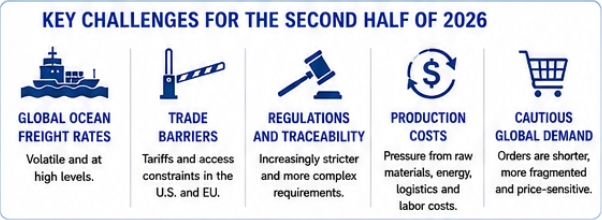
Beyond commercial risks, the spike in global container freight rates emerges as the main challenge for the second half of the year. The seafood industry requires a high proportion of shipments in refrigerated containers with strict temperature and punctuality controls, meaning any variation in freight rates, fuel surcharges, or port congestion directly affects margins and delivery capacity.
Click on the image to enlarge it
International container freight rates are approaching their highest levels in two years, reflected in surges of indicators like the Drewry World Container Index and the SCFI. This is largely due to US importers advancing bookings and orders to restock warehouses before new tariff policies take effect. This trend accelerated the peak import season, straining the spot freight market and making routes to North America and the European Union more expensive, where refrigerated transport costs are already structurally higher than dry cargo.
The $5.8 billion base achieved in the first half underpins projections to close 2026 with double-digit growth. For the remaining period, the sustainability of Vietnamese exports will depend on its ability to retain dynamism in China, ASEAN, and South Korea, elevate regulatory compliance in the United States, the European Union, and Japan, contain operating costs, and increase the supply of deeply processed, value-added products.
🇯🇵 日本語 (Japanese Version)
ベトナムの水産物輸出、2026年上半期に58億ドルに達するも、コストと物流の圧力は依然として継続
同セクターは中国と市場の多角化に牽引され12.8%の成長を確実なものとしたが、世界的なコンテナ運賃の高騰と米国および欧州連合における貿易障壁が下半期の業績を左右する。
ベトナムのペスカドス・イ・マリスコス(魚介類・水産物)セクターは、プラスの数字で今年の前半を締めくくった。2026年6月、水産物の輸出額はほぼ11億ドルに達し、2025年の同時期と比べて21.0%の増加を記録した。この結果により、年初からの6ヶ月間の累積輸出額はほぼ58億ドルに達し、12.8%の増加を確実なものとした。
中国および香港への輸出は引き続き大幅な増加を記録した一方、米国市場は6月に堅調な回復を示した。それとは対照的に、欧州連合(EU)、日本、中東は成長の鈍化またはわずかな減少を経験した。
ベトナム水産物輸出加工協会(VASEP)の副事務局長であるMs. Le Hangの報告によると、2026年上半期の成長は単なる需要の回復だけに起因するものではない。むしろ、企業が新しい市場へと転換し、製品構造を調整し、地理的近接性、低コスト、そして安定した消費需要を持つ地域をより良く活用する能力を反映している。VASEPは、この戦略的転換が、輸入業者がますます慎重になっている文脈の中で起きていることを強調した。「注文はより短く、より断片化する傾向にあり、より競争力のある価格を求め、品質、認証、トレーサビリティ、および納期に対するより厳格な管理を要求している」。
魚種別の動向
エビ(Penaeus monodon / Litopenaeus vannamei等)は、ベトナムの水産物産業において依然として最大の輸出グループである。2026年6月、同セクターの輸出は4億4,590万ドル(前年比20.7%増)に達した。上半期全体では、13.6%増の23億ドルに達し、同国の全水産物輸出額の40.5%を占めた。このセグメントは全体の成長の主要な原動力であり、年間目標を達成するための決定的な要素である。上半期の業績は中国と香港によって強力に支えられ、特にウシエビ(タイガーシュリンプ)、イセエビ・ロブスター類、冷凍エビ、およびレストランや高級消費市場向けの製品ラインが好調であった。
しかし、米国市場は依然として大きなボトルネックとなっている。6月に同国への水産物輸出が全体的に急増したにもかかわらず、エビ産業は、コスト、生産規模、原材料の面で優位性を持つエクアドル、インドネシア、インドなどの他の供給国からの激しい競争に直面している。さらに、アンチdumping(不当廉売)関税、相殺関税、SIMP(水産物輸入監視プログラム)、MMPA(海洋哺乳類保護法)、およびトレーサビリティ要件に関連するリスクが、ベトナム企業の規制遵守コストを押し上げ続けている。
一方、パンガシウス(Pangasianodon hypophthalmus)は、第2の輸出の柱としての地位を維持した。2026年6月、その出荷額は2億910万ドル(7.7%増)に達し、上半期には11億ドル(12.1%増)を累積、これは総輸出額の19.4%に相当する。この進展は、消費者の支出削減に直面しても、合理的な価格の白身魚に対する需要が安定していることを示している。ベトナム産のパンガシウスは、価格、大量供給、加工の柔軟性、そして小売、レストラン、産業用厨房、再加工などのチャネルへの適応性において優位性を持ち、競争を続けている。供給や貿易政策の影響を受けたタラ(Gadus morhua等)やスケトウダラ(Gadus chalcogrammus)など他の白身魚種の価格揮発性に直面する中で、パンガシウスは競争力を高めたが、原材料価格、養殖用飼料コスト、物流、そして米国における規制に関連する課題は依然として残っている。勢いを維持するため、業界は高度加工製品(カット、マリネ、パッケージ、および即食製品)のライン拡大に賭けている。
その他の魚種(主に海水魚および一部の淡水魚)のグループは、パンガシウスと同様の規模に達した。6月の輸出は1億9,880万ドル(+19.8%)を記録し、上半期の累積は11億ドル(+12.0%)に達し、全体の19.3%を占めた。ベトナムの供給の多様化を反映しているものの、この海洋漁獲セクターは、原材料の供給、および欧州連合(EU)の違法・無報告・無規制(IUU)漁業に対する規制や米国のMMPAといった合法漁獲認証やトレーサビリティの要求による厳しい圧力に直面している。
マグロ(Thunnus類)は混合した動きを示した。2026年6月には8,590万ドル(28.0%増)と回復を記録したものの、最初の6ヶ月の累積は4億5,270万ドルにとどまり、前数ヶ月の減少が響いて2.0%の減少となった。この市場は、購買力の停滞、缶詰製造コスト、持続可能な漁業への要求の高まり、さらには通関速度に影響を与える欧州連合の操業記録管理や電子トレーサビリティシステムによって条件付けられている。
軟体動物(イカ・タコ類)、カニ、ロブスターのセクターは明るい材料として際立っていた。6月のイカおよびタコの輸出は7,790万ドル(+26.5%)に達し、上半期で3億8,020万ドル(+18.8%)を累積、韓国、日本、タイ、中国などのアジア市場が牽引した。カニおよびその他の甲殻類は、6月に4,530万ドル(+55.1%)、上半期で2億620万ドル(+26.2%)に達した。二枚貝・貝類は6月に77.8%増(3,130万ドル)、累積で33.1%増(1億5,530万ドル)となった。その他の軟体動物は、小規模ながらも上半期に610万ドルに達し、84.4%の増加を記録した。
主要市場別の動向
-
中国および香港: 最大の輸入地域であり、最も明確な成長の原動力として定着している。6月には2億5,660万ドル(+32.2%)を吸収し、上半期を15億ドルで締めくくった。これは37.9%という目覚ましい増加であり、ベトナムの総輸出の25.8%を占め、エビ、パンガシウス、ロブスター、軟体動物、および生鮮・冷凍水産物の購入が際立っている。
-
米国: 6月に1億9,530万ドルで48.3%の反発を記録した。しかし、上半期の累積は8億9,790万ドルとなり、前年の同時期とほぼ同額であった。これは、6月の急増が短期的な注文に関連している一方で、在庫水準、価格競争、技術的障壁により全体の需要が依然として不安定であることを示唆している。
-
日本: 6月に1億5,020万ドル(+0.3%)に達し、累積で7億8,750万ドル(+0.7%)となった。エビ、イカ、タコ、マグロ、すり身において引き続き重要であるが、食品コストの高騰と円安のため、購買力の回復は緩やかである。
-
欧州連合: 6月に1億150万ドルを売り上げたが(+6.3%)、6ヶ月の累積は0.8%減少し、5億3,670万ドルとなった。IUUイエローカードと認証要求が引き続き漁獲セクターを圧迫している。
-
中東: 上半期に1億6,660万ドルを記録し、わずか0.1%の減少に相当する。
プラス面として、市場多角化戦略が他の地域で目に見える成果を上げた。韓国は4億1,940万ドル(+9.0%)、東南アジア諸国連合(ASEAN)は3億8,020万ドル(+15.8%)、その他の市場は合計で11億ドル(+17.1%)に達した。貿易政策の揮発性が低い近隣の目的地が、西側ブロックと日本の減速を補うのに役立った。
下半期の物流課題
商業的リスクを超えて、世界的なコンテナ運賃の上昇が下半期の主要な課題として浮上している。水産物産業は、厳格な温度管理と定時性を備えた冷蔵コンテナでの出荷の割合が高いため、運賃、燃料追加料金、または港湾混雑のいかなる変動も、企業の利益率と供給能力に直接影響を与える。
国際コンテナ運賃は過去2年間の最高水準に近づいており、Drewry World Container IndexやSCFIなどの指標の急騰に反映されている。これは主に、米国の輸入業者が新しい関税政策が発効する前に倉庫の在庫を補充するため、予約や注文を前倒ししていることによる。この傾向は輸入のピークシーズンを加速させ、スポット運賃市場を緊張させ、冷蔵輸送コストが乾燥貨物(ドライコンテナ)よりも構造的にすでに高い北米および欧州連合へのルートを高騰させている。
上半期に達成された58億ドルのベースは、2026年を2桁成長で締めくくるという予測の根拠となる。残りの期間、ベトナムの輸出の持続可能性は、中国、ASEAN、韓国でのダイナミズムを維持し、米国、欧州連合、日本における規制遵守を高め、オペレーティングコストを抑制し、付加価値の高い高度加工製品の供給を増やす能力にかかっている。
🇨🇳 简体中文 (Simplified Chinese Version)
越南水产品出口在2026年上半年达到58亿美元,但成本和物流压力依然存在
在中国和市场多元化的推动下,该行业巩固了12.8%的增长,而全球集装箱运费的高企以及美国和欧盟的贸易壁垒制约了下半年的业绩。
越南的水产品(鱼类和海鲜)行业在今年上半年取得了积极的成果。2026年6月,水产品出口额达到近11亿美元,与2025年同期相比增长了21.0%。凭借这一结果,今年前六个月的累计出口额上升至近58亿美元,巩固了12.8%的增长。
对中国和香港的出口继续录得强劲增长,而美国市场在6月显示出坚实的复苏。相反,欧盟、日本和中东则经历了增长缓慢或轻微下滑。
根据越南水产品出口商与生产商协会(VASEP)副秘书长Ms. Le Hang的报告,2026年上半年的增长并非仅仅源于需求的简单复苏。相反,它反映了企业向新市场转型、调整产品结构以及更好地利用具有地理邻近性、较低成本和稳定消费需求区域的能力。VASEP强调,这种战略转型发生在进口商变得越来越谨慎的背景下:“订单趋向于更短、更碎片化,要求更具竞争力的价格,并对质量、认证、可追溯性和交付时间提出更严格的控制。”
按鱼种划分的行业表现
虾类仍是越南表现最突出的水产品出口品种。2026年6月,该行业的出口额达到4.459亿美元(同比增长20.7%)。上半年累计达到23亿美元,增长13.6%,占该国水产品出口总额的40.5%。该细分市场是整体增长的主要驱动力,也是实现全年目标的关键因素。上半年的业绩得到了中国和香港市场的强劲支持,特别是在黑虎虾(草虾)、龙虾、冻虾以及针对餐饮和高端消费的产品线方面。
然而,美国市场仍是一个重要的瓶颈。尽管6月对该国的水产品出口整体激增,但虾类行业正面临来自厄瓜多尔、印度尼西亚、印度等在成本、生产规模和原材料方面具有优势的其他供应国的激烈竞争。此外,与反倾销税、反补贴税、SIMP(海鲜进口监测计划)、MMPA(海洋哺乳动物保护法)以及可追溯性要求相关的风险继续抬高越南企业的合规成本。
同时,鲶鱼(巴沙鱼)保持了其作为第二大出口支柱的地位。2026年6月,其出货量带来了2.091亿美元的收入(增长7.7%),上半年累计达到11亿美元(增长12.1%),相当于出口总额的19.4%。这一进展表明,在消费者削减开支的情况下,对价格合理的白肉鱼的需求保持稳定。越南的巴沙鱼继续在价格、大批量供应、加工灵活性以及对零售、餐饮、中央厨房和再加工等渠道的适应性方面保持竞争优势。面对受供应和贸易政策影响的其他白肉鱼类如鳕鱼和狭鳕的价格波动,巴沙鱼提高了竞争力,尽管原材料价格、水产饲料成本、物流以及美国监管要求的挑战依然存在。为了保持势头,该行业正致力于扩大深加工产品线(分切、调味、包装和即食产品)。
其他鱼类(主要是海洋鱼类和部分淡水鱼)的规模与巴沙鱼相当。6月其出口额达到1.988亿美元(+19.8%),而上半年累计达到11亿美元(+12.0%),占总额的19.3%。虽然这反映了越南供应的多元化,但这一海洋捕捞行业在原材料供应以及欧盟针对非法、不报告和管制(IUU)渔业的法规和美国的MMPA等合法捕捞认证和可追溯性要求上面临着严峻的压力。
金枪鱼表现出喜忧参半的走势。2026年6月录得复苏,达到8590万美元(增长28.0%),但前六个月的累计额仅为4.527亿美元,由于前几个月的下降而减少了2.0%。该市场受到购买力停滞、罐头加工成本以及对可持续捕捞实践要求提高的制约,加之欧盟的捕捞日志控制和电子追溯系统影响了清关速度。
软体动物(鱿鱼和章鱼)、螃蟹和龙虾行业成为亮点。6月的鱿鱼和章鱼出口达到7790万美元(+26.5%),上半年累计达到3.802亿美元(+18.8%),受韩国、日本、泰国和中国等亚洲市场的推动。螃蟹及其他甲壳类在6月达到4530万美元(+55.1%),上半年累计达2.062亿美元(+26.2%)。贝类在6月增长了77.8%(3130万美元),累计增长33.1%(1.553亿美元)。其他软体动物虽然规模较小,上半年达到610万美元,但录得84.4%的增长。
目的地市场表现
-
中国和香港: 巩固了作为最大进口区域和最明显增长驱动力的地位。6月吸纳了2.566亿美元(+32.2%),上半年收官于15亿美元,显著增长了37.9%,占越南出口总额的25.8%,在虾类、巴沙鱼、龙虾、软体动物以及鲜活和冷冻水产品的采购上表现突出。
-
美国: 6月以1.953亿美元录得48.3%的反弹。然而,上半年累计为8.979亿美元,与去年同期几乎持平。这表明6月的激增与短期订单有关,而由于库存水平、价格竞争和技术壁垒,整体需求仍然不稳定。
-
日本: 6月达到1.502亿美元(+0.3%),累计达7.875亿美元(+0.7%)。它仍然是虾类、鱿鱼、章鱼、金枪鱼和鱼糜的关键市场,但由于高昂的食品成本和日元疲软,购买力复苏缓慢。
-
欧盟: 6月营业额为1.015亿美元(+6.3%),但六个月累计下降了0.8%,停留在5.367亿美元。IUU黄牌和认证要求继续向捕捞行业施压。
-
中东: 上半年录得1.666亿美元,相当于轻微下降了0.1%。
在积极方面,市场多元化战略在其他地区取得了显着成效:韩国达到4.194亿美元(+9.0%);东南亚国家联盟(ASEAN)总计3.802亿美元(+15.8%);其他市场总计11亿美元(+17.1%)。贸易政策波动较小的邻近目的地有助于抵消西方阵营和日本的放缓。
下半年的物流挑战
除了商业风险外,全球集装箱运费的飙升成为下半年的主要挑战。水产品行业需要高比例的冷藏集装箱运输,并伴有严格的温度和准时性控制,这意味着运费、燃油附加费或港口拥堵 surcharge 的任何变化都会直接影响企业的利润率和交付能力。
国际集装箱运费正逼近两年来的最高水平,这反映在Drewry世界集装箱指数和SCFI等指标的暴涨中。这在很大程度上是因为美国进口商在新的关税政策生效前提前预订和下单以补充仓库。这一趋势加速了进口旺季,使即期运费市场陷入紧张,并推高了前往北美和欧盟的航线成本,在这些航线上,冷藏运输成本在结构上已经高于干货。
上半年实现的58亿美元基础为2026年底实现两位数增长的预测提供了依据。在剩余期间,越南出口的可持续性将取决于其保持在中国、ASEAN和韩国活力的能力,提高在美国、欧盟和日本的合规水平,遏制运营成本,并增加高附加值深加工产品的供应。
[email protected]
www.seafood.media
Information of the company:
|
Address:
|
218 Road No.6, Zone A, An Phu An Khanh New Urban Area, District 2
|
|
City:
|
Ho Chi Minh
|
|
State/ZIP:
|
( )
|
|
Country:
|
Viet Nam
|
|
Phone:
|
+84 28 6281 0430
|
|
Fax:
|
+84 28 6281 0437
|
|
E-Mail:
|
[email protected]
|
More about: 
|
|
|
|






.png)
.png)


 Print
Print