|
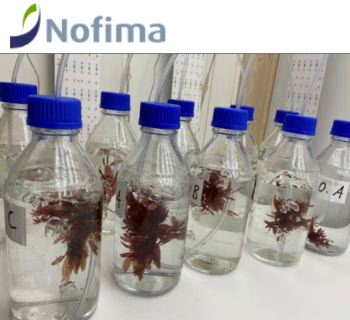
Dulse growing on different concentrations of effluent water from a RAS facility. Photo: Philip James/Nofima.
Harnessing Aquaculture Waste: Norway's Land-Based Red Algae Potential
 (NORWAY, 11/28/2025)
A Win-Win for Food Production, Business, and the Environment
A groundbreaking study in Norway suggests a pathway to boost food production, utilize nutrient-rich discharge water, and create new businesses by cultivating a valuable red algae known as dulse (Palmaria palmata) using waste from land-based salmon farming.
 Senior scientist Philip James and his colleagues investigated the optimal conditions for successfully producing dulse with good growth rates and color quality using discharge water from Recirculated Water Systems (RAS) in land-based salmon production. Senior scientist Philip James and his colleagues investigated the optimal conditions for successfully producing dulse with good growth rates and color quality using discharge water from Recirculated Water Systems (RAS) in land-based salmon production.
“I think this could be a win-win for both salmon producers, new businesses, and the environment,” says James.
Key Research Findings
The research, conducted using discharge water from SalMar’s land-based facility, yielded several significant findings:
-
Optimal Growth Conditions: Dulse demonstrated the best growth rates when cultivated in a mixture of 50 percent discharge water from the RAS facility and 50 percent seawater. This was compared to pure seawater, 25 percent, and 100 percent RAS discharge water.
-
Nutrient Removal Efficiency: A dilution rate of 50 percent provided the highest removal efficiency for key nutrients like ammonia and nitrate at this facility. For phosphate removal, efficiency was highest at a concentration somewhere between 25 percent and 50 percent RAS water.
-
Salinity Tolerance: Dulse grew equally well across a wide range of salinity, from brackish water to full seawater, equivalent to 10-32 grams salt per kilogram of seawater.
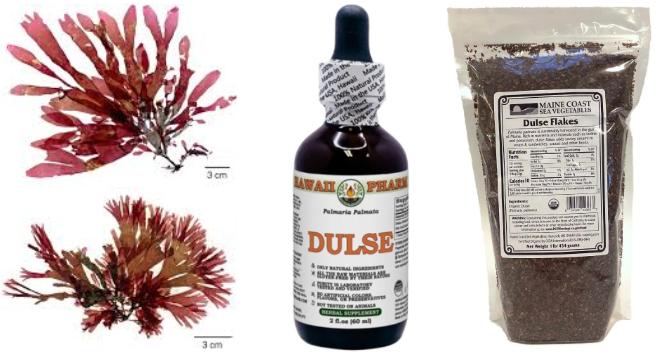
Red macroalga dulse, Palmaria palmata and commercial products
Striking Production Potential
The results underscore the substantial potential for a new seaweed industry. The study found that for every kilogram of fish feed used in RAS salmon farming, 257 grams of dulse could be produced.
Given that Norway’s land-based salmon industry consumes approximately 100,000 tonnes of feed annually, the nutrients in the discharge water could support a large-scale seaweed industry, effectively turning a waste product into a valuable resource.
“This underlines the potential for both macroalgae cultivation and utilizing RAS nutrients in discharge water as a valuable resource,” James notes, though he emphasizes that challenges still remain.
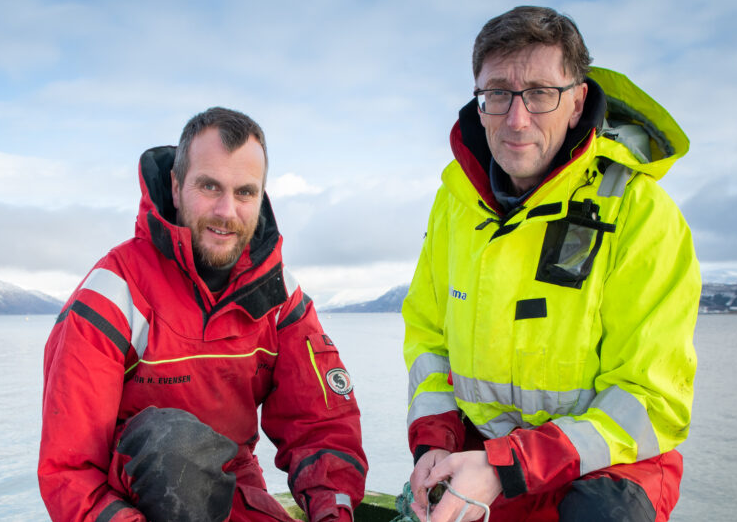
Research assistant Tor Evensen and senior scientist Philip James are researching the growth conditions of the macroalgae dulse. Photo: Lars Åke Andersen/Nofima.
Future Steps
In follow-up projects, scientists will continue testing dulse grown in RAS discharge water to assess its nutritional benefits and check for any potential harmful compounds.
“We did compare land-based and sea-based production in our last trial in 2025 and have samples away for biochemical comparison now. We will now move onto a full comparison of nutrients and PTEs (Potentially Toxic Elements), color, and taste between Palmaria grown at sea versus in discharge water in 2026,” James confirms.
The results stem from the ValueSøl research project, which is supported by the Regional Research Fund ARCTIC (RFF). Nofima is leading the collaboration, with the Norwegian University of Life Sciences (NMBU) and SalMar serving as project partners.
[email protected]
www.seafood.media
Information of the company:
|
Address:
|
Muninbakken 9-13
|
|
City:
|
Breivika
|
|
State/ZIP:
|
(N-9291)
|
|
Country:
|
Norway
|
|
Phone:
|
+47 77 62 90 00
|
|
Fax:
|
+47 77 62 91 00
|
|
E-Mail:
|
[email protected]
|
More about: 
|
|
|
|







 Print
Print