|
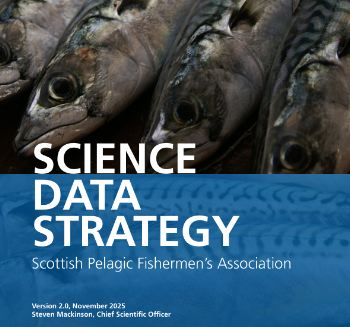
The revised document outlines how the association will engage its members and partners
Scottish Pelagic Sector Bolsters Commitment to Evidence-Based Fishing with New Science Strategy
 (UNITED KINGDOM, 1/8/2026)
The Scottish Pelagic Fishermen’s Association (SPFA) has officially updated its Science Data Strategy, marking a significant step forward in the industry's mission to ensure sustainability through rigorous data collection.
The revised document outlines how the association will engage its members and partners to establish reliable data streams for fish stock assessments and marine management.
Leading the Way in Industry-Led Research
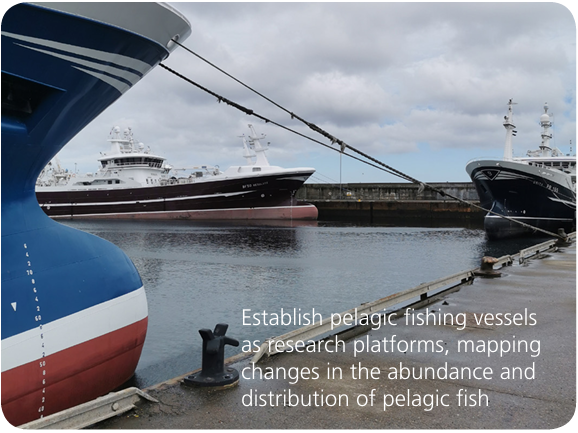
 The SPFA aims to position itself as a global leader in providing scientific data from the fishing industry. By demonstrating best practices for data access, the association seeks to bridge the gap between commercial fishing operations and scientific research. The SPFA aims to position itself as a global leader in providing scientific data from the fishing industry. By demonstrating best practices for data access, the association seeks to bridge the gap between commercial fishing operations and scientific research.
Dr. Steven Mackinson, Chief Scientific Officer for the SPFA, highlighted the importance of this initiative:
“The SPFA’s vision is for Scottish pelagic fishermen to be respected providers of scientifically credible data that’s used to assess fish stocks, monitor changes in the pelagic ecosystem and support management decisions.”
Addressing Modern Challenges in Marine Management
The strategy arrives at a critical time for the industry. As state-funded resources for evidence gathering decrease, the pressure on the fishing sector to prove its sustainability and defend its spatial footprint is rising.
Dr. Mackinson emphasized that the need for high-quality data is more urgent than ever:
“The association recognises that engagement in science is more important now than ever. While resources for state-funded evidence gathering have reduced, the need for quality data to assess the sustainability of fish stocks, and the businesses that depend upon them, continues to grow. Demands for data to evidence the spatial and temporal track record of fishing are also increasing at great pace due to the pressure resulting from competition for space from renewable energy developments, as well as plans to extend marine conservation areas.”
A Collaborative Future
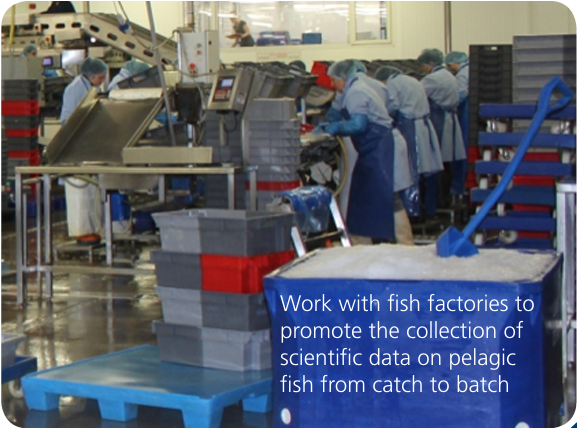
The updated strategy reflects a symbiotic relationship: scientists are looking to the fishing industry for monitoring support, while fishermen are seeking scientific expertise to navigate a complex regulatory and market environment.
“While science is more frequently turning to industry to help meet needs for monitoring and research, industry is turning to science for assistance with the professional skills it needs to operate effectively in a management system underpinned by data and science evidence, and markets that demand assurance of the sustainability credentials of fishing businesses,” Dr. Mackinson noted.
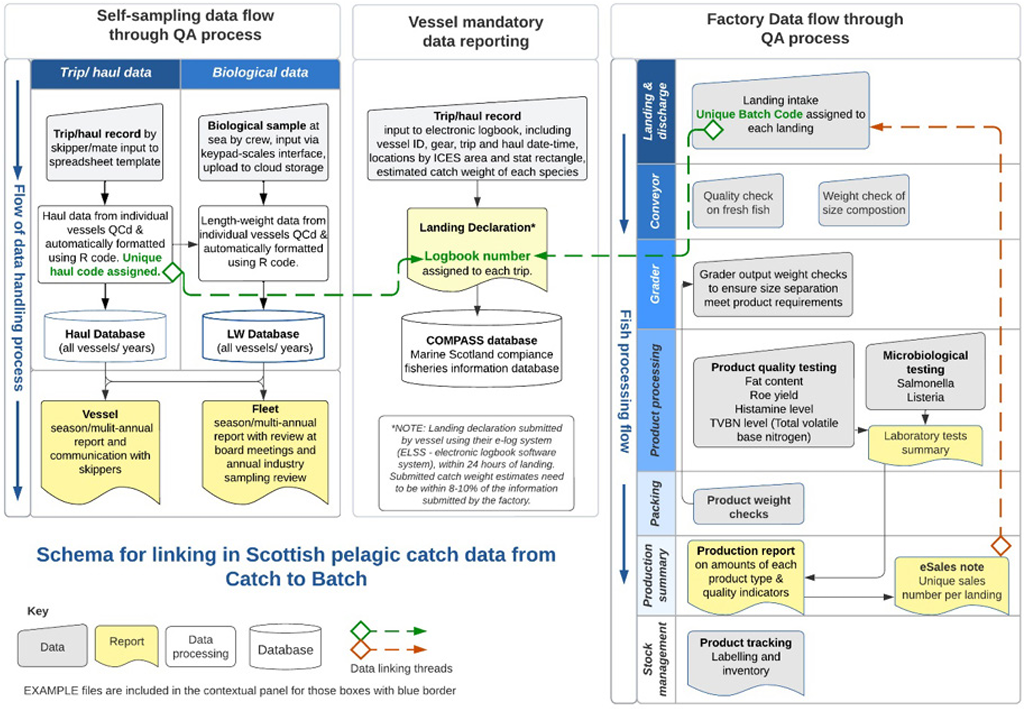
Catch to Batch concept schema. Click on the image to enlarge it
He concluded by stressing the importance of trust in the process: “Efforts toward improving data collection should be supported so that both the scientific advice, and management decisions that depend upon it, are reliable and trusted.”
[email protected]
www.seafood.media
Information of the company:
|
Address:
|
1 Frithside Street
|
|
City:
|
Fraserburgh
|
|
State/ZIP:
|
Aberdeenshire (AB43 9AR)
|
|
Country:
|
United Kingdom
|
|
Phone:
|
+44 1346 510 714
|
|
Fax:
|
+44 1346 510 614
|
|
E-Mail:
|
[email protected]
|
More about: 
|
|






.png)
 Print
Print