|
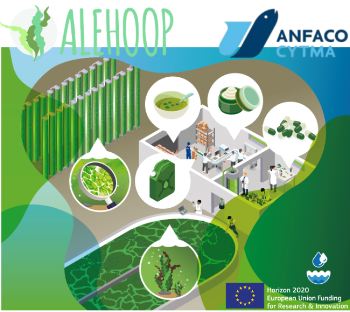
Partners from ANFACO show their pilot protein extraction from upwelling green algae
ALEHOOP Project Showcases Potential of Sustainable Proteins from Algae and Legumes: A Milestone in Europe's Circular Economy
 (EUROPEAN UNION, 7/30/2025)
After five years of research, the European project demonstrates the viability of producing high-nutritional-value ingredients, reducing carbon footprint, and transforming waste into useful resources for human and animal consumption.
BRUSELAS – The ambitious European ALEHOOP project has successfully concluded after nearly five years of intensive work and an investment of €5.1 million. Framed within the European Commission's Horizon 2020 program, this initiative lays the groundwork for a revolutionary model in sustainable protein production, utilizing residual plant biomass such as macroalgae and by-products from legume processing.

The international consortium behind ALEHOOP has validated, at pilot scale, various "green biorefinery" processes. These processes allow for the extraction of high-nutritional-value ingredients for both human and animal consumption, while significantly reducing environmental impact.
Galicia at the Forefront: Washed-Ashore Algae Transformed into Valuable Resource
One of the project's most notable achievements has been the valorization of green algae collected from the cleaning of clam and cockle beds in the Galician Rías Baixas. This work, led by ANFACO-CYTMA, transforms an environmental and economic problem into an opportunity

Each year, over 3,300 metric tons of this biomass are removed from the coast, incurring a significant economic cost for Galician fishing guilds. Thanks to the work developed within ALEHOOP, ANFACO has designed and validated a novel process that converts this biomass into functional proteins and fiber, suitable for use in aquaculture feed.
The developed process includes:
-
Microbubble cleaning and flotation: This removes up to 50% of sand and shells, improving the purity of the biomass.
-
Enzymatic hydrolysis: Achieving a 60% protein yield.
-
Filtration and drying: To stabilize the final product, optimized at laboratory scale and subsequently validated at pilot scale (TRL 6).

ANFACO-CYTMA's exhaustive analyses, along with validation by the University of Cádiz on its inclusion in aquaculture feed, confirm the utility and food safety of these proteins, highlighting their low environmental footprint. This advancement not only contributes to the circular economy and reduces the waste of marine resources but also improves the health of coastal ecosystems and opens new economic opportunities for Galician fishing communities, aligning with Sustainable Development Goals (SDGs) 2, 12, 13, and 14.
Plant Proteins and the Guide for Responsible Consumption
Beyond the Galician case, the ALEHOOP project has successfully validated the use of lupin and other legume by-products. From these, protein ingredients with up to 80% concentration have been obtained, which are already being used in functional foods and feed for fish, poultry, and piglets, showing improvements in animal health indicators.

An additional element of the project has been the development of a comprehensive guide on the responsible design of food products and their certification. This guide addresses the evaluation of sustainable packaging, the importance of clean labels, and the development of strategies to build consumer trust.
The Life Cycle Assessment (LCA) of all processes developed by ALEHOOP has demonstrated a significant reduction in carbon footprint, reaffirming the role of these biorefineries as a sustainable and high-impact alternative to conventional proteins.
[email protected]
www.seafood.media
Information of the company:
|
Address:
|
Ctra. Colegio Universitario, 16
|
|
City:
|
Vigo
|
|
State/ZIP:
|
Pontevedra, Galicia (36310)
|
|
Country:
|
Spain
|
|
Phone:
|
+34 986 469 301
|
|
Fax:
|
+34 986 469 269
|
|
E-Mail:
|
[email protected]
|
More about: 
|
|
|
|






 Print
Print